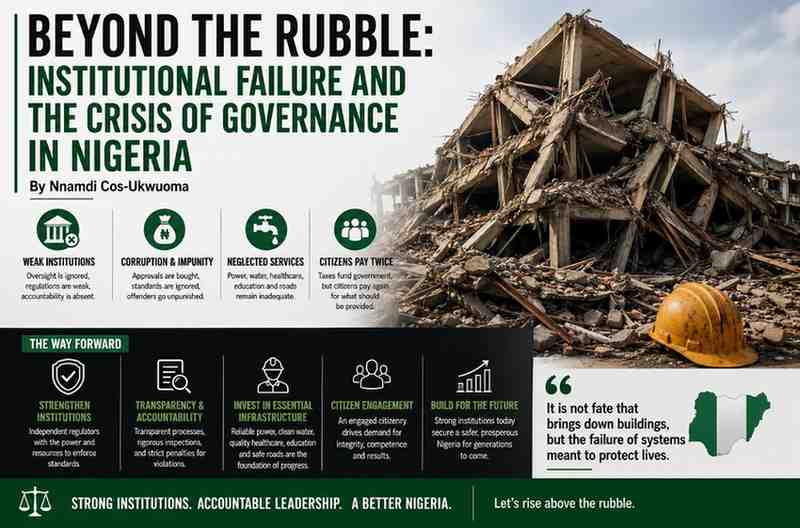
What began as an ordinary day in the quiet community of Umuduru, Alaoma Owerre-Ebeiri, Orlu, turned into a stark illustration of a problem that should deeply concern every Nigerian who yearns for a safer and more functional society. A three-storey hostel building, without warning, crumbled into a chaotic heap of concrete, twisted rebar and dust in the ungodly hours of the night.
By sheer luck, lives were spared. While we rightly celebrate the absence of fatalities, we must not let this fortunate outcome lull us into complacency. The collapse of that building casts a shadow far beyond its immediate vicinity, forcing us to confront a deeper, systemic rot that has steadily eroded the very foundations of our nation: the pervasive failure of public institutions.
The tragedy in Umuduru was more than just the destruction of a physical structure; it was a visible manifestation of collapsed oversight, a breakdown in regulation, a void in accountability and a shirking of responsibility. It laid bare the perilous consequences of a system where the very institutions meant to safeguard citizens are themselves crippled by corruption, negligence, sheer incompetence and political meddling.
Every collapsed building tells a story. It speaks of approvals granted without due diligence, of inspections either botched or entirely bypassed, of contractors cutting corners, developers prioritizing profit over people’s safety and officials failing to enforce the rules. Buildings rarely succumb to mere fate; they fall because our systems falter or more aptly put, outrightly fail.
Across Nigeria, the alarming frequency of building collapses has become a grim norm.
From bustling metropolises to burgeoning towns, structures that should endure for generations are prematurely succumbing to decay. Each incident follows a depressingly familiar script: public outcry, official inquiries, pronouncements of reform, and then, inevitably, silence until the next disaster strikes.
The critical question isn’t why buildings collapse. It’s why the very institutions established to prevent such calamities consistently fail in their fundamental duties.
Unfortunately, the challenges Nigeria faces extend well beyond the construction industry. What we are witnessing is a broader crisis of governance and institutional effectiveness. A nation’s strength isn’t measured solely by its natural wealth, its population size or its economic indicators. Nations thrive or falter based on the robustness of their institutions. Strong institutions ensure fair enforcement of laws, safeguard public assets, deliver essential services and hold leaders to account. Weak institutions do the opposite, fostering an environment where corruption thrives, impunity reigns and public trust disintegrates.
Today, millions of Nigerians grapple daily with the tangible consequences of institutional failure. Citizens pay taxes, yet are left to shoulder the burden of providing many of the services the government is obligated to guarantee. Reliable electricity remains an elusive dream, despite decades of promises and billions poured into reform efforts. Public water systems have become either inadequate or entirely defunct in countless cities and local communities. Healthcare facilities are buckling under the strain of insufficient funding, a shortage of personnel and outdated equipment. Public schools continue to contend with crumbling infrastructure and declining educational standards. Roads, which should be conduits for economic progress, too often become hazards to life and property.
Consequently, Nigerians are trapped in a painful cycle of self-reliance. Families buy generators because electricity is unreliable. They drill private boreholes because public water systems are insufficient or practically inexistent. They hire private security because faith in public safety has waned. They pay for private schooling because many public institutions no longer inspire confidence. In essence, citizens are funding the government through taxes while simultaneously footing the bill for services the government has failed to deliver.
This double burden has become a significant driver of the escalating cost of living.
Nothing highlights this paradox more starkly than the growing reliance on alternative power solutions, even at the highest echelons of government. While embracing renewable energy is commendable and aligns with global best practices, it raises troubling questions when public institutions themselves appear to have lost faith in the very systems they are tasked with managing.
The symbolism is potent. If those in positions of power must seek alternatives to public utilities, what hope can ordinary citizens, who lack the means to do the same, possibly have?
At the core of this crisis lies a culture that has normalized institutional weakness.
Over time, merit has too often been sidelined in favour of patronage. Professional standards have frequently been sacrificed for political expediency. Regulatory bodies, which should operate with autonomy, have become susceptible to undue influence. Accountability mechanisms, designed to deter misconduct, have become inconsistent and, in many instances, ineffective.
The result is a system where citizens increasingly encounter selective enforcement of rules, where competence is undervalued and where public service is sometimes viewed as a personal springboard rather than a vehicle for national advancement.
The cumulative effect is devastating.
Weak institutions deter investment, inflate the cost of doing business, erode public confidence and fuel unemployment, poverty and social unrest. Most critically, they create a society where preventable tragedies become a grim, recurring phenomenon.
History offers a crucial lesson. Nations that have successfully transformed their economies and elevated their citizens’ quality of life didn’t achieve this solely through abundant resources. Their success stemmed from building institutions that could enforce standards, maintain transparency, reward competence and ensure continuity, irrespective of political shifts.
Nigeria possesses all the factors and endowments that make a nation great: a dynamic population, entrepreneurial drive, vast natural resources and immense intellectual capital. What remains underdeveloped are the very institutions needed to effectively leverage these strengths.
Moving forward demands both courage and unwavering commitment.
Regulatory bodies must be fortified and shielded from undue influence. Building permits require transparent processes and rigorous professional review. Inspections must be conducted consistently and honestly. Public officials who compromise standards must face fitting penalties, regardless of their social standing, political ties or economic clout.
Equally vital is sustained investment in essential infrastructure. Reliable electricity, clean water, quality healthcare, effective education and safe transportation networks are not optional amenities. They are fundamental responsibilities of good governance and the bedrock of national progress.
Citizens, too, have a critical role. Democracy thrives when citizens remain alert and actively involved. Public accountability falters when silence supplants scrutiny. Nigerians must consistently demand transparency, competence, integrity and tangible results from those in public office.
The collapsed hostel in Umuduru, Alaoma Owerre-Ebeiri, Orlu in Imo State must not fade into another forgotten news item. It should serve as a stark warning and a profound lesson. It must remind us that institutional failure isn’t an abstract concept confined to policy discussions. It carries tangible consequences: it destroys property, endangers lives, hampers development and erodes public confidence.
Most significantly, it diminishes the future we aspire to build for generations to come.
The rubble in Umuduru is therefore more than just broken concrete. It symbolizes the outcome of systemic breakdown and neglected responsibilities. It’s a stark reminder that the true foundation of any thriving nation isn’t steel, cement or physical structures, but robust institutions built on integrity, professionalism and accountability.
Nigeria’s greatest challenge isn’t a lack of potential. It’s the urgent imperative to rebuild the institutions capable of translating that potential into tangible progress.
Until accountability supplants impunity, competence replaces mediocrity and service supersedes self-interest, the cycle of avoidable failures will unfortunately continue.
The task before us, therefore, extends beyond reconstructing collapsed buildings. It is the critical mission of rebuilding public trust, restoring institutional credibility and reinforcing the very foundations of governance.
Only then can Nigeria truly rise above the rubble.
Nnamdi Cos-Ukwuoma writes from Umuduru, Alaoma Owerre-Ebeiri, Orlu, Imo State.