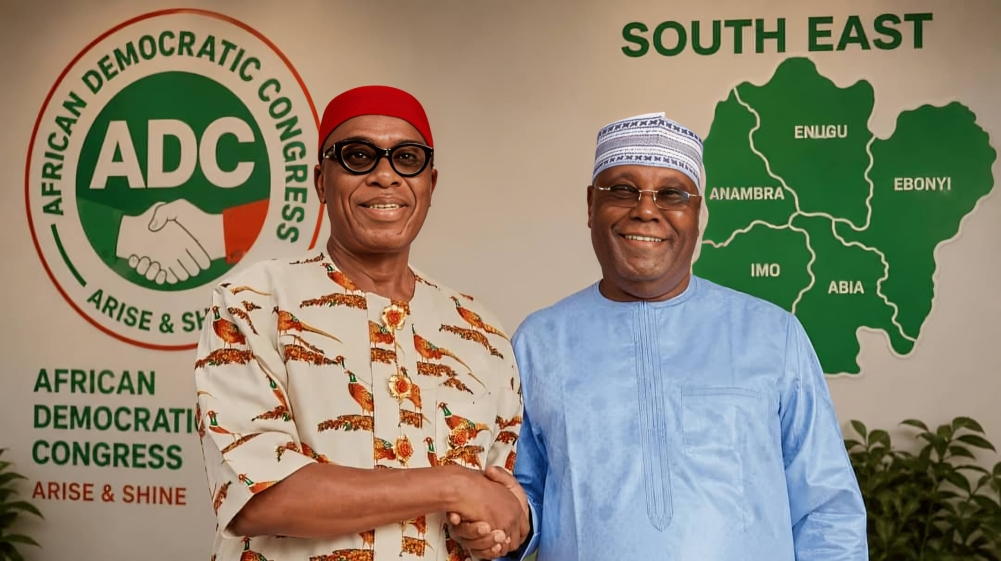
The decision by the African Democratic Congress (ADC) to nominate former Rivers State Governor and former Minister of Transportation, Rotimi Amaechi, as the running mate to its presidential candidate, Atiku Abubakar, has done more than settle an internal party calculation. It has reopened an old wound in the South-East and reinforced a long-held suspicion that when it comes to the distribution of political power in Nigeria, the Igbo are often invited to participate but rarely permitted to lead. In politics, symbolism matters. Appointments matter. Choices matter. And the ADC’s choice has sent a message that many in the South-East find difficult to ignore.
The questions are inevitable. Why was the South-East once again overlooked? Why did Atiku, a politician who has enjoyed substantial goodwill across Igboland for decades, decide that the region was not worthy of occupying the vice-presidential slot? Why has a region that consistently demands inclusion become the easiest to exclude whenever the most consequential political decisions are being made? These are not emotional questions. They are legitimate political questions arising from a pattern that is becoming increasingly difficult to dismiss as coincidence.
What makes the development even more perplexing is Atiku’s history with the South-East. This is not a man who lacks political connections in the region. He once chose Ben Obi as his running mate. He later selected Peter Obi as his vice-presidential candidate. Throughout his political career, he cultivated alliances with influential political figures from the South-East and projected himself as a bridge-builder across Nigeria’s ethnic divides. Yet, despite this history, his recent political choices tell a different story. In 2023, he settled for Ifeanyi Okowa , then Delta State Governor from the South-South. In 2027, he has chosen Amaechi. The South-East, once again, has been left standing outside the room.
Perhaps this explains why Peter Obi’s departure from the ADC now appears more strategic than emotional. There is growing reason to believe that Obi understood the internal dynamics of the party better than many of his supporters. He may have realized that the ADC was never going to seriously entertain the possibility of a South-East presidential candidate. He may also have understood that even the vice-presidential ticket was beyond reach. If that assessment was correct, then his migration to the National Democratic Congress (NDC) was not an act of impatience but an act of political self-preservation.
The burden now falls on ADC leaders and supporters in the South-East. They must explain to their people why the zone should continue investing political capital in a party that has shown little inclination to reward that loyalty. They must explain why Igbo voters should embrace a platform whose most important electoral decision has reinforced the very grievances that have alienated the region from other major political parties. They must explain why the South-East should once again settle for promises when other zones are receiving political positions.
What is even more surprising is that the ADC appears not to have learned from the electoral struggles of the All Progressives Congress (APC) in the South-East. Since its formation, the APC has battled a perception problem in the zone. Despite years in power, despite federal appointments, despite political defections, despite enormous investments in political mobilization, the party has never succeeded in building deep electoral roots across much of Igboland. The reason is simple. Many voters believe the APC has never genuinely accommodated South-East aspirations at the highest levels of national leadership.
That perception persists despite the contributions of prominent Igbo politicians to the party’s growth. Men such as Late Ogbonnaya Onu, Rochas Okorocha, Emeka Nwajiuba and several others invested years of political labour in building the APC. Today, Governor Hope Uzodimma remains one of the party’s most influential figures nationally, while governors from Ebonyi and Enugu have further expanded the APC’s presence in the region. Yet electoral acceptance remains limited because many voters continue to ask a fundamental question: what exactly has the South-East gained from its support?
The ADC had a historic opportunity to distinguish itself from that pattern. Many believed that while Atiku’s emergence as presidential candidate was practically guaranteed, the vice-presidential slot offered an opportunity to send a powerful signal of inclusion. Such a decision would not merely have been symbolic; it would have acknowledged the growing agitation for political equity and national balance. Instead, the party chose a different route. In doing so, it surrendered an opportunity to build a strong emotional and political connection with one of Nigeria’s most politically conscious regions.
The truth is that the ADC has now joined a long list of political parties accused of treating the South-East as an electoral afterthought. Since 1999, no major political party has successfully entrusted its presidential ticket to an Igbo candidate under circumstances that reflected genuine party consensus and support. The PDP has failed to do so. The APC has failed to do so. Now the ADC appears unwilling to break that cycle. Consequently, the feeling of exclusion that fuels political resentment in the region continues to deepen with every election cycle.
Ultimately, the Amaechi nomination is not merely about one man or one ticket. It is about perception, trust, and political memory. The South-East remembers. It remembers promises made and promises abandoned. It remembers alliances formed and alliances betrayed. The ADC may argue that elections are won through strategic calculations, but politics is also about legitimacy and inclusion. In a region where many already feel structurally excluded from the highest levels of power, the decision to bypass the South-East once again may prove costly. The party has every right to choose its candidates. The South-East equally has every right to draw conclusions from those choices. And increasingly, those conclusions are not flattering.