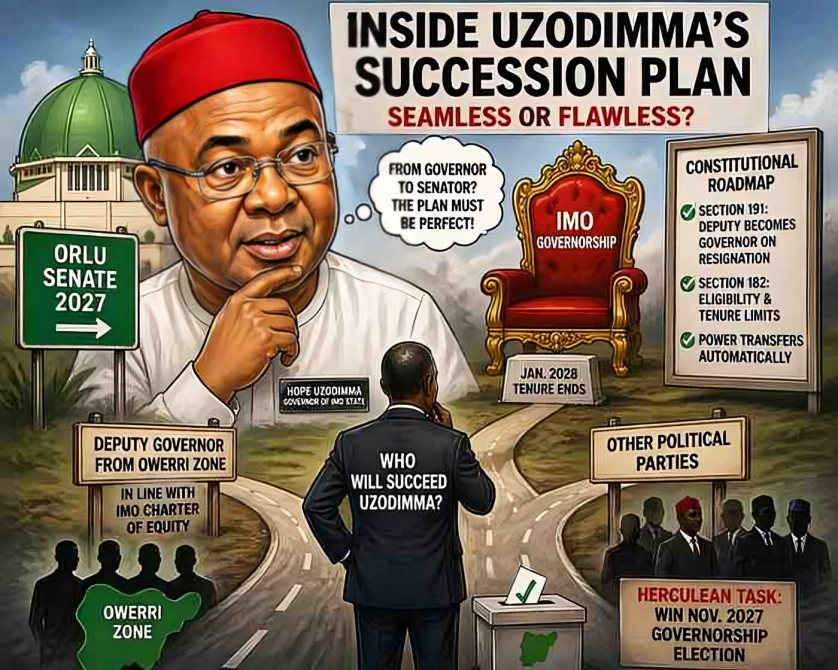
The political future of Imo State could enter a constitutionally unusual phase in June 2027 if Governor Hope Uzodimma wins the Imo West Senatorial election and subsequently leaves office to take his seat in the National Assembly, months before the expiration of his second term in January 2028. The prospect has raised a fundamental question that is increasingly attracting attention in political circles: who will govern Imo State between Uzodimma’s possible departure for the Senate and the inauguration of a governor elected in the November 2027 off-cycle governorship election?
Uzodimma’s Possible Senate Move Raises Constitutional Questions
Uzodimma is expected to remain in office while contesting the 2027 senatorial election, as the Constitution does not bar a sitting governor from seeking another elective position. The constitutional complication would arise after he wins and seeks to assume his Senate mandate. The next National Assembly is expected to be inaugurated around June 2027, creating a gap of several months between the possible commencement of his senatorial tenure and the end of his constitutionally recognised tenure as governor. Under such a scenario, Uzodimma would have to vacate the governorship through a constitutionally recognised process before assuming the Senate seat.
The succession question is further complicated by uncertainty surrounding the deputy governorship. Reports have circulated about the status of Deputy Governor Chinyere Ekomaru, while speculation has also persisted that Uzodimma could appoint a new deputy governor before his possible departure. INNONEWS reported in April that rumours of a possible new deputy appointment had gained traction amid calculations surrounding the governor’s anticipated senatorial bid, although there was no official confirmation from the Imo State Government at the time. The constitutional position, however, is that where the office of deputy governor becomes vacant, the governor nominates a replacement subject to confirmation by the State House of Assembly.
Who Takes Over If the Governor Leaves Office?
Political analyst John Ozoemena said the situation remains unclear because it is not yet known whether Uzodimma will appoint a new deputy governor before leaving office or retain the existing arrangement. He said the identity and status of whoever occupies the deputy governorship at the point Uzodimma exits office could become central to the transition, particularly because the person could be required to serve as acting governor during the period leading to the November 2027 off-cycle governorship election. “It is not clear if Uzodimma will appoint a new deputy governor. That will determine who becomes acting governor when he leaves in June 2027,” Ozoemena said.
The 1999 Constitution provides a framework for dealing with a vacancy in the office of governor. Under Section 191, where the office of governor becomes vacant, the deputy governor assumes the office and completes the unexpired tenure. If there is no deputy governor, the Speaker of the State House of Assembly temporarily assumes the office, with the Constitution providing for an election to fill the vacancy within the prescribed period. This means the precise constitutional status of the deputy governorship in Imo before June 2027 would be critical to determining the immediate succession arrangement if Uzodimma leaves for the Senate.
Deputy Governor’s Status Could Hold the Key
The political calculations surrounding the transition have already intensified. INNONEWS reported in April that succession planning had become one of the most consequential issues in Imo politics, particularly amid speculation that Uzodimma could return to the Senate after previously representing Orlu Senatorial District. The report noted that a deputy governor appointed ahead of his possible departure could become a crucial figure in the transition, especially if the person is drawn from Owerri Zone in accordance with the political expectations surrounding the Imo Charter of Equity. The Charter, although not a constitutional instrument, has become a significant political reference point in the debate over which zone should produce Uzodimma’s successor.
For now, Uzodimma has kept his cards close to his chest and has not publicly indicated whom he intends to support as his successor. That silence has fuelled speculation within the ruling All Progressives Congress, with political actors and potential aspirants trying to decipher the governor’s intentions. INNONEWS reported in February that the governor’s continued silence had left political allies and party members guessing, with no clear public signal at the time identifying a preferred successor. More recently, however, the newspaper reported that the process of determining his successor had begun, while the President of the Owerri Zone Awareness Coalition (OZAC), Emmanuel Okwu, said in June that Uzodimma had already settled on a preferred successor, although the identity of the alleged choice has not been publicly disclosed or officially confirmed.
2027 Succession Battle- Between Constitution and Politics
The possibility that Uzodimma could unveil his preferred successor within the next few months has therefore added another layer to the succession debate. Such an announcement, if it occurs, could clarify whether the governor intends to back a candidate from Owerri Zone, as many political actors expect under the Charter of Equity, or pursue a different political arrangement. INNONEWS has previously reported that Uzodimma told Owerri Zone political leaders in August 2025 that he lacked the power to simply handpick his successor, while other reports have continued to suggest that the governor’s eventual choice will carry considerable weight within the APC.
The most immediate question, however, is not necessarily who will win the 2027 governorship election but who will occupy Government House, Owerri, in the months before that election is held. If Uzodimma leaves office in June 2027 after winning the Senate seat, the person constitutionally positioned to take over will depend largely on the status of the deputy governorship at that time. That person could potentially oversee the state during the transition and preside over the administration in the run-up to the November 2027 poll. Whoever occupies that office would, however, still have to face the electorate if he or she seeks to become the substantive governor beyond January 2028.
The emerging succession puzzle therefore places Imo at the intersection of constitutional procedure and high-stakes political calculation. Uzodimma’s possible move to the Senate, the status of the deputy governorship, the identity of his preferred successor and the November 2027 governorship election are all closely connected. For now, the governor has offered no definitive public roadmap on how these events will unfold. Until he does, one question will continue to dominate political conversations across the state: if Hope Uzodimma leaves Imo for the Senate in June 2027, who exactly will govern Imo until the people elect his successor?
: READ ALSO: