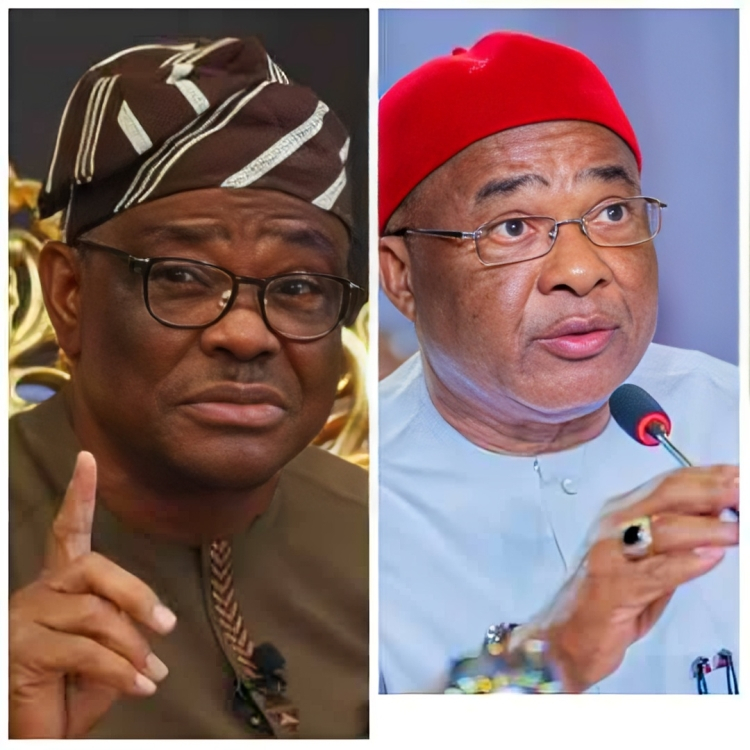
Some political quarrels are born as whispers and mature into wars. The widening breach between FCT Minister, Nyesom Wike and Imo State Governor, Hope Uzodimma is beginning to acquire that ominous trajectory. What looks like a disagreement over President Bola Tinubu’s 2027 re-election is, on closer inspection, a contest over something more enduring: political influence, control of electoral machinery and the architecture of power that could emerge after Tinubu’s second term. Wike and Uzodimma were once political allies. In May 2023, Wike, then governor of Rivers State, bestowed Rivers State’s highest honour, the Grand Service Star, on Uzodimma and publicly celebrated his political strength. Politics, however, has a peculiar way of converting yesterday’s embrace into today’s battlefield.
The immediate detonator is Wike’s Rainbow Coalition. His proposition is politically simple but structurally disruptive. For Wike, politicians from different parties can support Tinubu for president without joining the APC and without surrendering their right to support candidates of other parties for governorship and legislative elections. In Wike’s political grammar, presidential loyalty does not automatically translate into sub-national party loyalty. The APC governors speak a different political language. Following their meeting in Abuja, the Progressive Governors Forum, chaired by Uzodimma, rejected arrangements that could weaken the APC or its candidates. Wike has accused Uzodimma and Kwara Governor AbdulRahman AbdulRazaq of working against him while maintaining that his principal objective remains Tinubu’s re-election. The disagreement has therefore moved beyond personalities into a contest over who gets to define what loyalty to Tinubu means.
And therein lies the real contradiction. Wike’s formula potentially gives Tinubu something every incumbent president craves, which is a political constituency larger than his party. But what enlarges the presidential tent can simultaneously shrink the political room available to the party’s governors. A politician can vote for Tinubu and vote against an APC governorship candidate. He can campaign for the President while campaigning against an APC senatorial candidate. He can therefore be simultaneously useful to the presidency and inconvenient to the party. Wike’s Rainbow Coalition is built around precisely this political elasticity. Uzodimma’s resistance is an attempt to impose rigidity on it. What Wike regards as coalition-building, the APC governors can regard as the creation of a parallel political machine beneath the presidential ticket.
The shadow of 2031 makes the quarrel more intriguing. If Tinubu secures another term in 2027, the succession calculations will begin almost before the confetti settles. Most Nigerian politicians understand this arithmetic instinctively: political capital accumulated today becomes bargaining power tomorrow. Wike therefore has reason to demonstrate that his influence is not dependent on the formal machinery of the APC. Uzodimma, whose governorship will end after the next presidential contest, has equally strong reasons to consolidate his national relevance. He has secured the APC ticket for the Imo West senatorial election, potentially moving his political base from Douglas House to the National Assembly with an eye on the Senate presidency. What either men ultimately seeks in 2031 remains a matter of political interpretation, not established fact. But that both are building political capital for the future is hardly an exotic proposition.
Uzodimma’s current political assignments explain why his confrontation with Wike carries unusual weight. He is governor of Imo, chairman of the Progressive Governors Forum, chairman of the Southeast Governors Forum and secretary of the APC Presidential Campaign Council. He is therefore simultaneously a state governor, a regional political actor and an important cog in the ruling party’s presidential machinery. Wike occupies an altogether different but equally consequential position, a federal minister serving under Tinubu while retaining influence within the PDP’s fractious political ecosystem. His Rainbow Coalition is an attempt to convert that peculiar political location into leverage. What we are witnessing, therefore, is not simply Wike versus Uzodimma. It is a contest between two competing theories of political power. One built around a broad presidential coalition that transcends party boundaries and another built around the disciplined machinery of the governing party.
That is the sword of Damocles now hanging over the APC. Tinubu may benefit from political support beyond the APC, but the APC governors must protect the party’s own electoral interests. Wike wants the presidential project to be bigger than the party; Uzodimma wants the presidential project to remain compatible with the party. Both positions contain an internal logic, and both contain a potential contradiction. The danger is that the machinery assembled to produce presidential unity could become a collection of competing centres of power. The immediate prize is 2027, but the deeper contest is over who will possess the networks, alliances and bargaining power when the political map begins to change after it. In Nigerian politics, today’s presidential coalition can become tomorrow’s succession battlefield. The cracks, as they say, usually appear before the roof comes down.