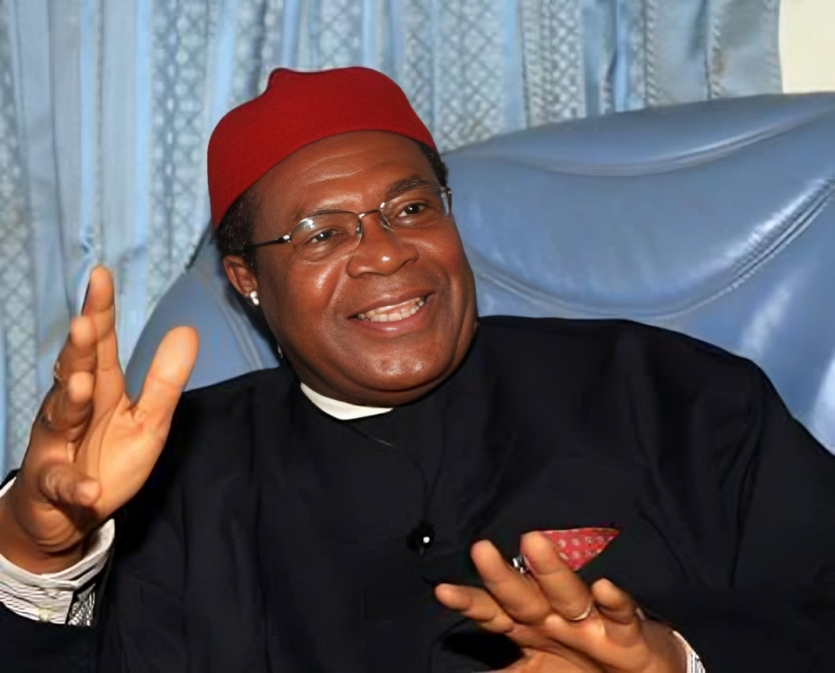
Former Enugu State governor, Okwesilieze Nwodo, has faulted political leaders from the South-East who have declared support for the All Progressives Congress (APC) and President Bola Ahmed Tinubu, insisting they do not represent the true feelings of the region’s people.
Speaking on ARISE News and monitored by our correspondent in Enugu, Nwodo said elite political endorsements in the South-East are disconnected from grassroots opinion and do not mirror how ordinary citizens think or vote.
According to him, public sentiment across the region sharply contrasts with the posture adopted by some governors and influential politicians who have aligned with the ruling party.
“These are leaders who are not speaking the mind of our people,” Nwodo said, stressing that popular opinion can easily be gauged from everyday interactions in markets, streets and communities.
He questioned the rationale behind the growing wave of defections to the APC, particularly by governors, noting that many Nigerians are yet to see any compelling justification for such moves.
Nwodo argued that neither the ideology of the APC nor the performance of the federal government under its control provides a persuasive reason for opposition figures to abandon their platforms.
He warned that the trend could signal a dangerous drift toward a one-party system driven by convenience rather than clear ideas or measurable governance outcomes.
Responding to suggestions that South-East leaders are distancing themselves from former Anambra State governor, Peter Obi, now associated with the African Democratic Congress (ADC), Nwodo said political choices are often guided by personal interests rather than collective conviction.
He clarified that the ADC is focused on holding the current administration accountable on policy delivery while presenting Nigerians with credible alternatives, including the ideas and solutions offered by Obi.
Nwodo maintained that the APC’s increasing grip on political elites has failed to translate into mass support in the South-East, citing Enugu State as a clear example.
He recalled that before 2023, the Peoples Democratic Party (PDP) dominated elections at all levels in the state, while the APC struggled to gain relevance.
According to him, the APC’s poor showing in the 2023 governorship election, where its candidate polled just 14,000 votes statewide, underscored its weak grassroots appeal.
Nwodo said the rise of the Obedient Movement further altered the political landscape, sweeping aside established loyalties and leaving an even stronger undercurrent of public resistance to the APC.
He stated that while incumbency and federal power may embolden the ruling party, they cannot easily override public consciousness, urging Nigerians to push for electoral reforms and remain actively engaged ahead of the 2027 elections to safeguard democracy and demand better governance.