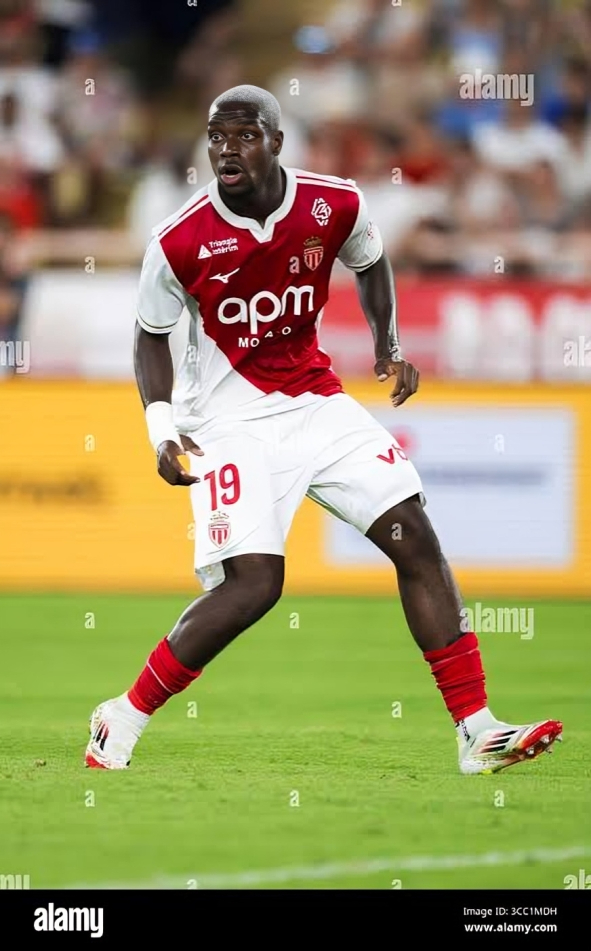
Nigerian football is once again confronted with a familiar but urgent question: how quickly should emerging talents in Europe be integrated into the Super Eagles? The case of George Ilenikhena, the Lagos-born teenage striker currently plying his trade with AS Monaco, has brought this debate into sharp focus.
At just 19, Ilenikhena has already built a résumé that many senior professionals would envy. From breaking age-related scoring records in France’s Ligue 2 to delivering decisive goals in the UEFA Champions League with Royal Antwerp and now AS Monaco, his trajectory suggests a forward on an accelerated development curve.
Beyond the statistics, Ilenikhena’s performances point to a striker comfortable on big stages. His goals in European competition underline composure under pressure—an attribute the Super Eagles have often lacked in critical tournament moments, particularly against disciplined and tactically sound opponents.
Nigeria’s attacking options remain rich but uneven. While the Super Eagles boast experienced forwards, there is a noticeable gap in terms of youthful, high-tempo strikers who can stretch defenses with pace and intensity across a full match. Ilenikhena’s profile aligns closely with this tactical requirement.
The timing of an invitation is also strategic. Born in Nigeria but raised in France, Ilenikhena has represented France at youth level and remains eligible for both countries at senior level. Delayed engagement from Nigeria risks repeating past scenarios where highly rated dual-national players ultimately commit their international futures elsewhere.
From a sporting standpoint, early inclusion does not necessarily translate into immediate dependence. An invitation to a Super Eagles camp—especially for a friendly or low-risk competitive fixture—would allow the technical crew to evaluate his readiness while gradually exposing him to the team’s structure and demands.
There is also a strong symbolic value. Extending an invitation to a teenager excelling in Europe sends a clear message that the Super Eagles are driven by form and performance rather than reputation alone. Such a signal would resonate across the growing pool of Nigerian talents in Europe.
Concerns about age and experience are understandable, yet modern football continues to challenge old assumptions. Elite national teams increasingly trust young players who display maturity, tactical intelligence, and confidence—qualities Ilenikhena has demonstrated consistently at club level.
For the Super Eagles coach, the decision should be viewed less as a gamble and more as strategic planning. With major qualifiers and tournaments on the horizon, integrating Ilenikhena early could secure Nigeria a long-term attacking asset rather than a reactive solution.
Ultimately, the issue is not whether George Ilenikhena is the finished product, but whether Nigeria can afford to overlook a striker developing at such speed on Europe’s biggest stages. An invitation would be both a footballing statement and a proactive move to safeguard Nigeria’s attacking future.