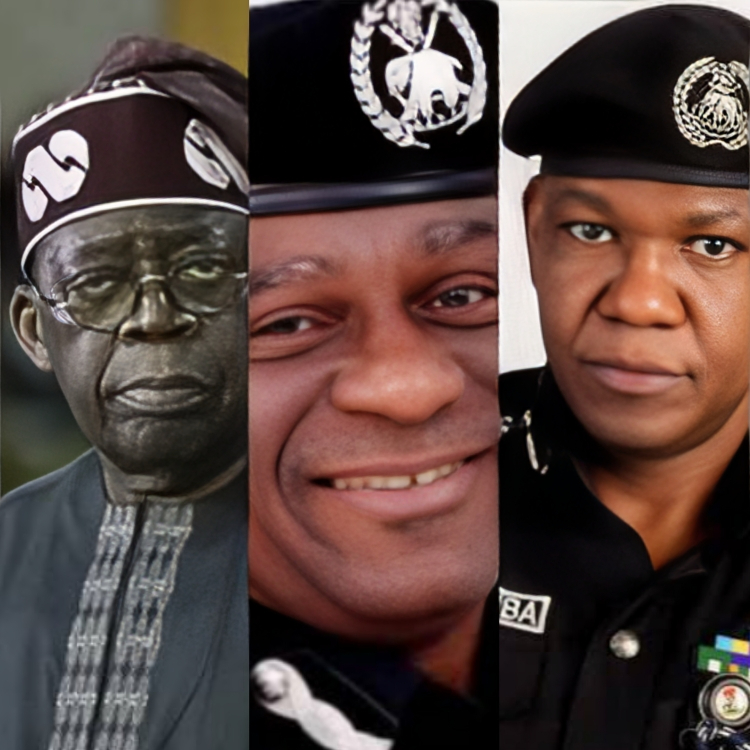
President Bola Ahmed Tinubu has appointed Tunji Disu as the new Inspector-General of Police. In a country where symbolism is substance and appointments are political texts, this decision is more than an administrative reshuffle; it is a statement of power, preference, and perhaps prejudice. At a time when Nigeria’s fragile federation requires delicate balancing, Tinubu’s choice detonates old anxieties about inclusion, hierarchy, and the ever-elusive promise of federal character.
On the surface, Disu’s résumé is serviceable. He has held command positions, navigated volatile terrains, and cultivated a reputation for operational firmness. But policing in Nigeria is not merely about professional competence; it is also about national cohesion. The office of the IGP is one of the most symbolically potent in the federal architecture. It is the face of coercive authority. It must therefore reflect the plural soul of the country—or risk amplifying the centrifugal forces already tugging at its seams.
What makes this appointment combustible is the quiet but unmistakable bypassing of senior officers in the established hierarchy. Reports indicate that several Deputy Inspectors-General and senior Assistant Inspectors-General were superseded. Among them is DIG Frank Mba, a refined, media-savvy, and widely respected officer from the South-East. In the structured ladder of the Nigeria Police Force, seniority is not a decorative ornament; it is institutional grammar. To disrupt it without transparent justification invites suspicion.
Mba is not a lightweight in the force. His tenure as Force Public Relations Officer marked a rare moment when police communication approximated professionalism. He articulated policy with clarity, defended institutional positions with composure, and projected intellectual gravitas. Even critics concede his polish. If merit, hierarchy, and national balancing were the metrics, his candidacy would not have been implausible.
The larger issue, however, transcends individual ambition. The South-East has long complained of systematic exclusion from the commanding heights of federal power. The last Inspector-General of Police from the region was Ogbonna Onovo, who served from 2009 to 2010 under President Umaru Musa Yar’Adua. That was over a decade and a half ago. Since then, the region has watched the strategic security architecture of the country crystallize without its visible imprint.
In a federation that constitutionally enshrines federal character, optics matter. When a particular region repeatedly misses out on critical appointments—especially in security—the message received is not bureaucratic; it is existential. It communicates distance from the centre of power. It entrenches the feeling that some Nigerians are perennial spectators in a republic they equally own.
Tinubu’s defenders will argue that appointments must be competence-driven, not geography-driven. It is a seductive argument. But Nigeria is not a homogenous polity where technocracy alone can anesthetize identity anxieties. Federal character is not an ornamental clause in the constitution; it is a conflict-management mechanism born out of historical fractures. Ignoring it in the name of efficiency is not reformist; it is reckless.
The optics become even more troubling against the backdrop of accusations—fair or exaggerated—that the Tinubu administration has disproportionately favored Yoruba kinsmen in key federal positions. Whether in finance, security, or strategic agencies, the perception of ethnic clustering has hardened. Leadership is not only about what is done; it is also about how it is perceived. And perception, in politics, is often reality’s more potent twin.
This is where the irony becomes stinging. Elements within pro-Tinubu advocacy groups, including voices aligned with the so-called “City Boys Movement,” have urged the South-East to “align with the centre.” Alignment, in political grammar, implies reciprocity. It suggests that loyalty will be met with accommodation. But when the most consequential security office eludes the region once again—despite available senior and competent officers—alignment begins to look like unilateral surrender.
The appointment also raises a delicate question: what message does this send to officers from marginalized regions within the force? Policing, like any bureaucracy, runs on morale as much as authority. When career trajectories appear capped by invisible ceilings, institutional faith erodes. The Nigeria Police Force cannot afford a crisis of confidence at a time when the country’s security challenges are metastasizing.
None of this is an indictment of Tunji Disu’s personal competence. He may well discharge his duties with distinction. But leadership choices in plural societies are never ideologically neutral. They either stitch together the national fabric or widen its frayed edges. Tinubu had an opportunity to signal magnanimity, balance, and strategic inclusiveness. Instead, he has ignited a debate about equity.
In the end, this is not about one man’s promotion or another man’s disappointment. It is about the moral architecture of governance under President Tinubu. If the administration genuinely seeks national cohesion, it must move beyond rhetorical appeals for unity and demonstrate it through deliberate inclusiveness in consequential appointments. Anything less will validate the suspicion that federal character is invoked selectively—and that some regions are expected to perpetually align without ever truly belonging.