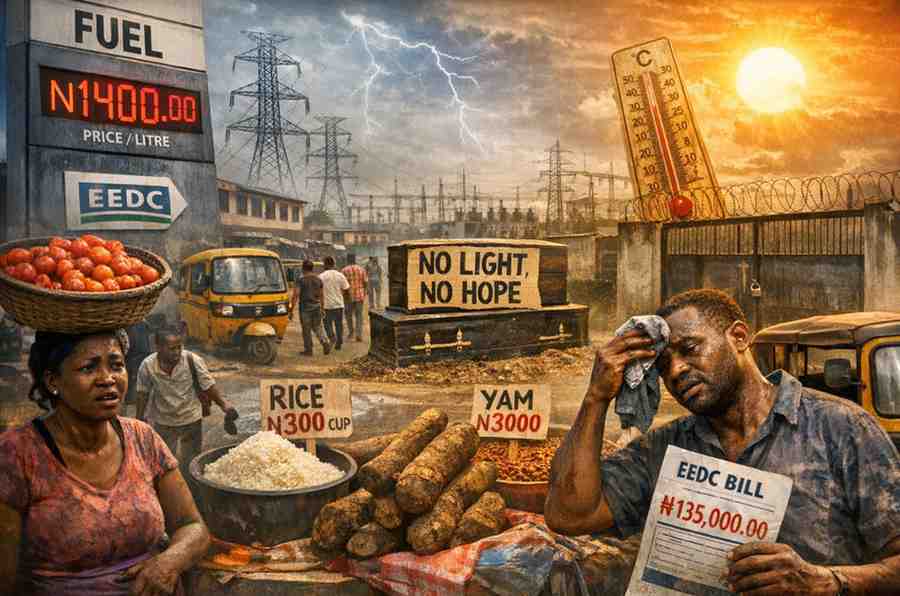
Residents of Owerri, the Imo State capital, are grappling with worsening economic hardship following the rise in the pump price of petrol to about N1,400 per litre, a development that has triggered increases in transportation fares and food prices.
Findings by INNONEWS show that the combined effect of rising fuel costs and declining purchasing power has placed significant strain on households, with many residents adjusting their daily routines to cope with the situation.
There is also a noticeable reduction in vehicular movement across major roads and streets in the city, as fewer car owners take to the roads due to the high cost of petrol.
Commuters now rely more on trekking or limiting their movements, while commercial drivers report a drop in passenger traffic amid rising fares.
Mercy Uba, a resident, said the situation has become unbearable for many families struggling to meet basic needs. “Everything has increased — transport, food, even the smallest things. It is getting very difficult to survive,” she said.
Remigious Eke described the development as painful, noting that residents are facing severe economic pressure. “People are suffering seriously. The government needs to understand what Nigerians are going through,” he said.
Another resident, Anselem Onwudiwe, criticised the increase in petrol price, saying it has affected every aspect of daily life. “There is no justification for this kind of increase. It is making life harder for everyone,” he said.
A resident identified simply as Chinedu said families are now forced to make tough financial decisions. “You have to choose between feeding and transportation. It is not easy anymore,” he said.
An economic analyst, Sampson Uchegbu, dismissed claims that the increase in fuel price is linked to tensions in the Middle East, including reports about the closure of the Strait of Hormuz.
He said the Strait of Hormuz is mainly a transit route for crude oil shipments to Asia and does not directly affect supply to Nigeria or Africa. He also criticised the Tinubu administration, accusing it of failing to respond adequately to the hardship faced by citizens and warning that the situation may worsen.
Transportation fares within Owerri have increased significantly, with commuters now paying between N400 and N500 for trips within the metropolis, depending on distance.
At Eke Ukwu and Relief markets, traders confirmed a rise in the prices of staple food items. A cup of rice now sells for about N300, up from N250, while beans has increased from N200 to N250 per cup. A tuber of yam now costs between N2,000 and N3,000.
The situation is compounded by persistent electricity outages across the city and surrounding areas, with some communities experiencing days without power supply. The outages have coincided with rising temperatures, which sometimes exceed 30°C, leaving residents to endure intense heat without electricity.
In Egbu community, where the Transmission Company of Nigeria (TCN) power station is located, youths staged a protest over the prolonged blackout, dropping a coffin at the facility to express their anger.
Residents also decried what they described as high electricity bills from the Enugu Electricity Distribution Company (EEDC), with some households reportedly receiving monthly bills ranging from N120,000 to N150,000 despite poor power supply.
Business owners say the combined effect of high fuel prices and unreliable electricity is affecting productivity, as many are forced to rely on alternative power sources. “Do they want us all to die before the government knows we are going through a lot?” said Uju Nwokeji, a businesswoman.