The consolidation of opposition heavyweights—Atiku Abubakar, Peter Obi and the expected entry of Rabiu Kwankwaso—into the Africa Democratic Congress (ADC) has redefined the early contours of the 2027 presidential race, setting up what could become Nigeria’s most consequential electoral contest since 1999.
At the core of the emerging battle is a simple but compelling question: can a unified opposition convert numerical advantage into a disciplined political coalition capable of dislodging an incumbent president backed by the full weight of state power?
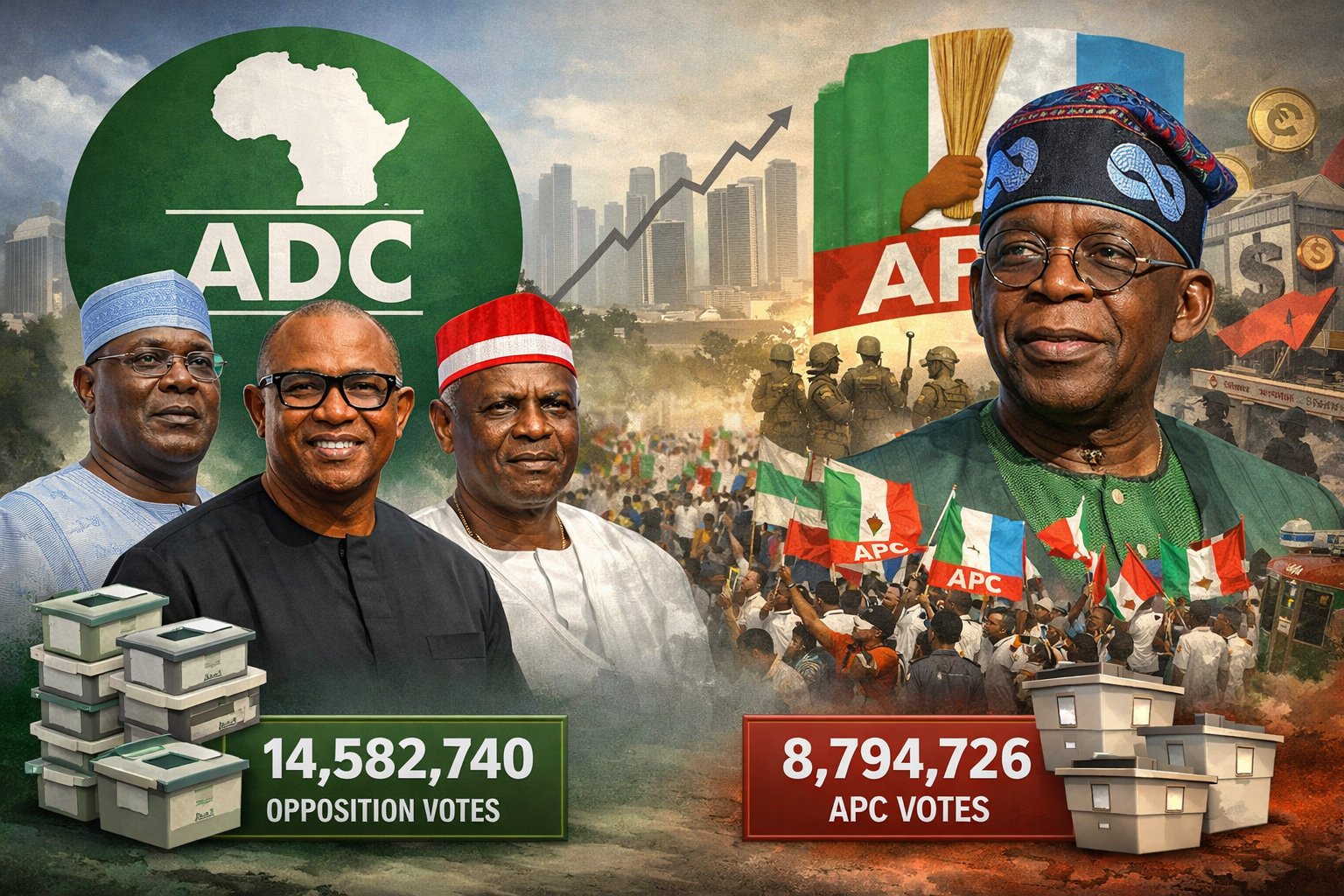
The 2023 presidential election provides the clearest empirical baseline. President Bola Tinubu of the APC won with 8,794,726 votes (36.61%). Atiku Abubakar of the PDP secured 6,984,520 votes (29.07%), Peter Obi of the Labour Party polled 6,101,533 votes (25.40%), while Rabiu Kwankwaso of the NNPP obtained 1,496,687 votes (6.23%).
Aggregated, the three opposition figures recorded 14,582,740 votes, exceeding Tinubu’s tally by 5,788,014 votes. Even after accounting for overlaps, turnout variations and shifting alliances, the data underscores a structural reality: the opposition’s fragmentation, more than lack of support, delivered victory to the APC in 2023.
This arithmetic explains the strategic significance of the ADC’s emergence as a common platform. A consolidated ticket could reconfigure voting patterns across key regions—particularly the North-West, North-Central and South-East—where opposition votes were previously split.
However, Tinubu enters the 2027 cycle with entrenched incumbency advantages. The APC’s control of about 32 states—following a wave of defections by PDP governors—translates into dominance over subnational political machinery, including grassroots mobilisation networks, patronage systems and election-day logistics.
Beyond political structure, the president is expected to anchor his re-election bid on a reform-driven economic agenda. Key policies include the removal of petrol subsidy in May 2023, which eliminated a fiscal burden estimated at over ₦4 trillion annually, and the unification of foreign exchange windows, which led to a sharp depreciation of the naira but was designed to improve transparency and attract investment inflows.
Additional measures include increased revenue mobilisation through tax reforms, efforts to clear central bank financing of fiscal deficits, and a shift towards market-based pricing mechanisms in critical sectors.
Yet, the macroeconomic adjustments have imposed severe short-term costs. As of early 2026, headline inflation exceeds 30 percent, with food inflation above 35 percent, according to data from the National Bureau of Statistics. The naira has lost substantial value against the dollar since mid-2023, amplifying import costs and eroding household purchasing power.
The World Bank estimates that over 40 percent of Nigerians—more than 90 million people—live below the poverty line, with recent reforms pushing additional millions into economic vulnerability. Real wages have declined, and energy costs—particularly fuel and electricity—have risen sharply, intensifying cost-of-living pressures.
These indicators create a politically sensitive environment for the incumbent. Elections in Nigeria are often influenced by immediate economic realities, and widespread hardship could weaken the APC’s appeal, particularly among urban voters, youths and informal sector workers.
On the opposition flank, however, structural weaknesses persist. The ADC currently has no sitting governor, raising questions about its institutional capacity to match the APC’s nationwide apparatus. Still, the 2023 precedent complicates this assumption: Peter Obi, without a single governor under the Labour Party, won 12 states, including Lagos and the Federal Capital Territory.
The decisive variable, therefore, is not merely structure but cohesion. The ADC’s presidential primary will be a high-stakes test of internal democracy and elite bargaining. Atiku, Obi and Kwankwaso each command distinct regional bases: Atiku in the North-East and parts of the North-West, Obi in the South-East and urban South-South/South-West clusters, and Kwankwaso with a stronghold in Kano and segments of the North-West.
Obi’s publicly stated willingness to serve a single four-year term—effectively restoring power to the North by 2031—introduces a strategic concession aimed at easing zoning tensions. But its acceptance is uncertain, particularly among entrenched northern political interests and party stakeholders seeking longer-term influence.
The central risk is fragmentation after the primary. If Atiku secures the ticket, will Obi’s support base—largely youth-driven and reform-oriented—transfer loyalty to him? If Obi emerges, will northern blocs align fully behind a southern candidate despite zoning sensitivities? And if Kwankwaso is sidelined, can the ADC retain his Kano-based vote bank, which alone delivered nearly 1.5 million votes in 2023?
Ticket configuration will be critical. An Atiku-Obi pairing could merge northern political structure with southern electoral energy, but may face trust deficits among Obi’s base. An Obi-Kwankwaso ticket could consolidate youth and North-West votes, but risks elite resistance. Each permutation carries measurable electoral implications.
Ultimately, the 2027 election may not be decided by popularity alone but by organisational discipline and elite consensus. If the ADC manages a transparent primary, enforces post-primary unity, and aligns its regional strengths into a single electoral machine, it could pose the most serious challenge to incumbency in Nigeria’s Fourth Republic.
If it fails, the numbers that suggest vulnerability for the APC may instead reinforce a familiar outcome: a divided opposition conceding victory to a well-entrenched ruling party.