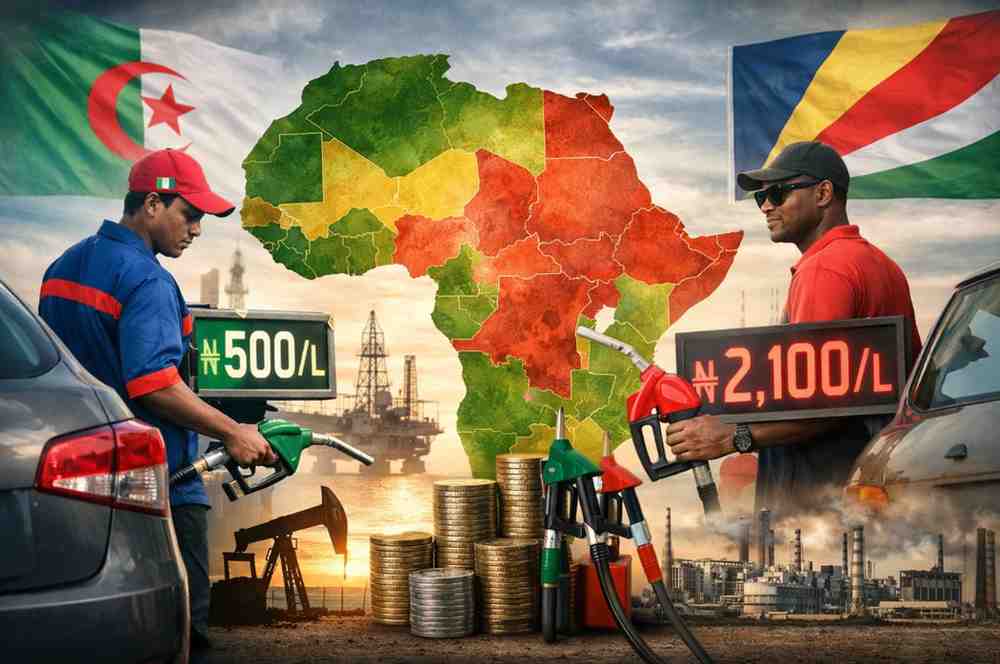
Fuel prices across Africa have taken a sharply divergent trajectory, with countries like Algeria maintaining some of the lowest pump prices on the continent, while others such as Seychelles and Rwanda continue to grapple with significantly higher costs.
Recent data for March–April 2026 shows that petrol sells for as low as about ₦500 per litre in Algeria, making it one of the cheapest destinations for fuel in Africa. The North African country continues to sustain low prices through heavy government subsidies, insulating citizens from global oil market volatility.
In contrast, Morocco has adopted a largely deregulated pricing system, with petrol now selling between ₦1,800 and ₦2,000 per litre. The shift reflects the country’s market-driven approach, where pump prices are directly influenced by international crude oil rates and exchange rate fluctuations.
A similar pricing pattern is observed in South Africa, where fuel costs currently range from ₦1,700 to ₦1,900 per litre, with authorities adjusting prices monthly in line with global benchmarks.
Island nation Seychelles ranks among the most expensive, with petrol exceeding ₦2,100 per litre, largely due to its dependence on imported refined petroleum products and high logistics costs.
In East Africa, Burundi and Rwanda also record elevated fuel prices, averaging between ₦1,900 and ₦2,050 per litre, driven by supply constraints and foreign exchange pressures.
Fresh data also highlights sharp contrasts in other parts of the continent. In oil-rich Angola, petrol remains relatively cheap at about ₦450–₦470 per litre, reflecting continued subsidies and domestic crude production advantages.
However, prices spike significantly in parts of West Africa. Senegal sells petrol at about ₦2,280 per litre, while Ivory Coast records around ₦2,030 per litre, placing both among the most expensive fuel markets on the continent.
In Mali, petrol prices hover around ₦1,800–₦2,000 per litre, while Madagascar also falls within the higher price bracket due to import-dependent pricing structures.
Analysts note that a significant number of these high-cost countries are not major oil producers like Nigeria, relying heavily on imported refined petroleum products, which exposes them to global price shocks and logistics costs.
Despite being a leading crude oil producer, Nigeria faces its own structural challenges. The country’s state-owned refineries remain largely obsolete and non-functional, leaving a major supply gap in domestic refining capacity.
This has placed increased reliance on private sector intervention, particularly the emergence of the refinery owned by billionaire industrialist Aliko Dangote, which is expected to play a critical role in stabilising supply and pricing over time.
Nigeria currently sits mid-range on the continental price scale, with petrol selling between ₦1,150 and ₦1,200 per litre following the removal of fuel subsidies.
President Bola Ahmed Tinubu recently argued that Nigerians are better off in terms of fuel prices compared to many other African countries, a claim broadly supported by current pricing trends across the continent.
Analysts say the prevailing price regime has also been influenced by geopolitical tensions, particularly the conflict involving Iran, which has contributed to volatility in global crude oil markets. They add that prices may ease if a sustained ceasefire involving the United States, Israel and Iran holds.
The latest figures underscore a widening disparity in fuel costs across Africa, shaped by subsidy policies, geography, and import dependence, with far-reaching implications for inflation, transportation, and economic stability.