There are moments in the life of a nation that ought to inspire pride. There are others that should induce shame.
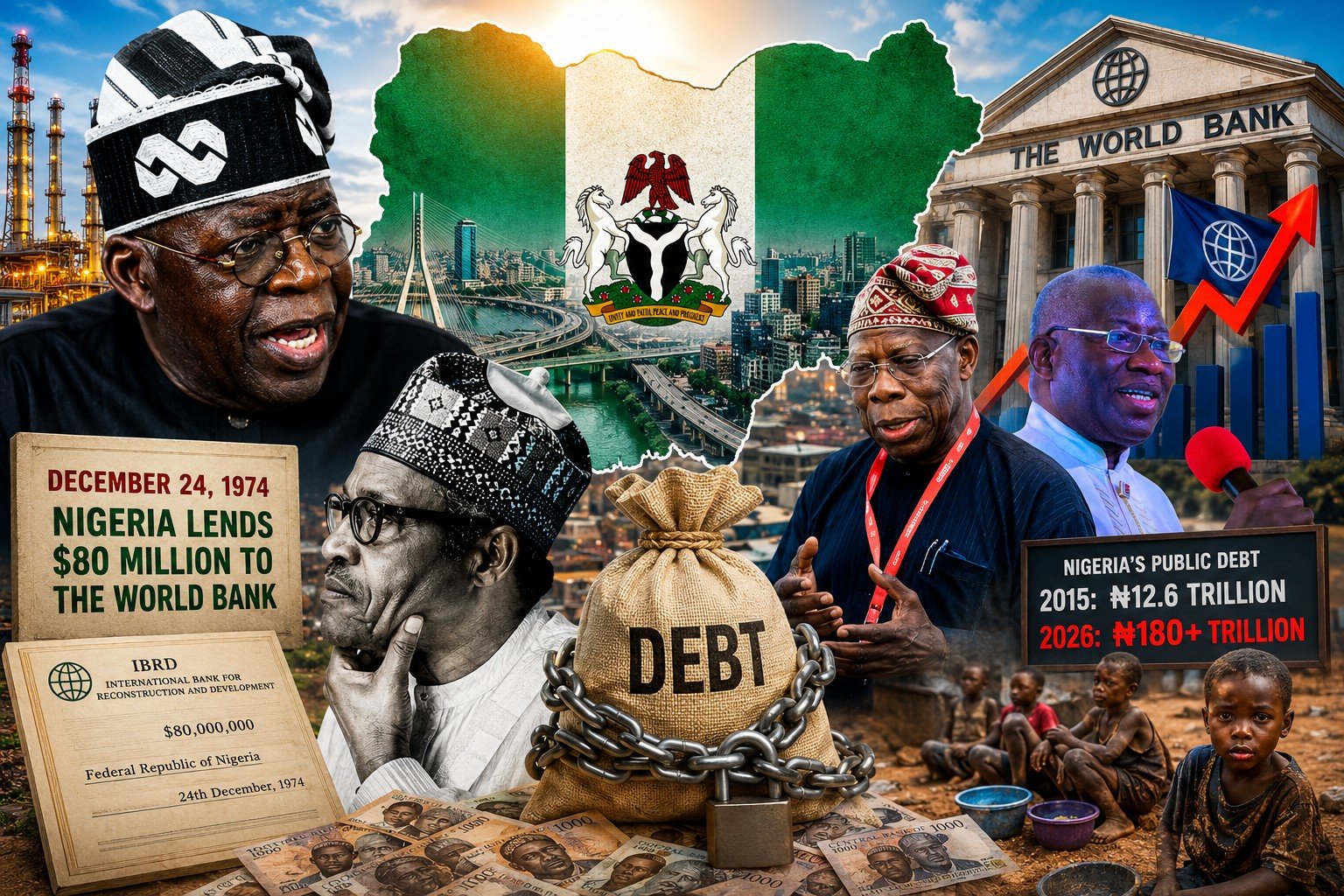
Nigeria’s decision on December 24, 1974, to lend about $80 million to the International Bank for Reconstruction and Development (IBRD), the lending arm of the World Bank, belongs firmly in the first category. It reflected the confidence of a country buoyed by oil wealth, swelling foreign reserves and the conviction that its future lay among the world’s rising economies.
More than five decades later, that confidence has evaporated. The Nigeria of today is not a lender. It is a borrower of habit, a debtor by policy and a nation mortgaging tomorrow merely to survive today.
The transformation is one of the most astonishing reversals in modern economic history. According to Nigeria’s Debt Management Office (DMO), the country’s public debt has ballooned from about ₦12.6 trillion in 2015 to well over ₦180 trillion by 2026, driven by relentless domestic borrowing, Eurobonds, multilateral facilities and bilateral loans.
Debt accumulation has become the defining feature of public finance. Every fiscal challenge is answered with another loan. Every budget deficit is plugged with borrowed money. Governments have become addicted to debt because they have failed to build an economy capable of sustaining itself.
This addiction did not begin with President Bola Ahmed Tinubu. It has flourished under successive administrations that substituted borrowing for reform. From the era of cheap global credit to the post-pandemic borrowing spree, federal governments discovered that it was politically easier to borrow than to broaden the productive economy, expand the tax base intelligently, reform public enterprises or confront entrenched corruption.
The result is a fiscal structure sustained more by creditors’ confidence than by productive economic output.
Yet the Tinubu administration has shown little appetite for breaking this cycle. Instead, borrowing has accelerated alongside sweeping economic reforms. The removal of petrol subsidies, the floating of the naira and repeated requests for fresh domestic and external loans have been presented as unavoidable prescriptions for national recovery.
Ministers speak of infrastructure financing and fiscal sustainability. But citizens, confronted daily by crushing hardship, have every right to ask where the promised dividends remain. A government cannot ask people to endure endless sacrifice while offering only projections instead of measurable improvements.
The contradiction is impossible to ignore. Nigeria continues to borrow on an extraordinary scale, yet the visible outcomes remain painfully scarce. Power generation remains unreliable. Manufacturers struggle under exorbitant energy costs. Public hospitals lack basic equipment. Schools deteriorate. Roads remain unfinished long after contracts have been awarded.
The infrastructure deficit persists despite decades of borrowing supposedly undertaken to eliminate it. Debt has become abundant; development remains elusive.
Meanwhile, the social consequences are becoming impossible to conceal. Inflation has eroded incomes with relentless force. Food prices have climbed to levels unimaginable only a few years ago. Rice, beans, garri, bread and cooking oil have become luxury items for millions of households.
The World Bank has repeatedly warned that economic pressures have pushed millions more Nigerians below the poverty line. Hunger is no longer confined to the unemployed. It now stalks civil servants, artisans, pensioners and even sections of the once-comfortable middle class. The country is witnessing not merely economic distress but the slow erosion of human dignity.
Borrowing is not inherently reckless. Britain borrows. The United States borrows. Japan borrows on a scale that dwarfs most economies. The difference is brutally simple.
Those countries borrow to strengthen productive capacity, deepen innovation and expand economic competitiveness. Nigeria, by contrast, too often borrows merely to finance consumption, refinance old obligations, service previous debts and sustain an oversized government apparatus. Loans have become a substitute for governance rather than an instrument of development.
The bitter irony cannot be overstated. The nation that once supplied capital to the World Bank now repeatedly turns to the same international financial institutions for assistance, policy advice and credit.
This reversal cannot be blamed solely on fluctuating oil prices or global economic shocks. It is the cumulative consequence of decades of policy inconsistency, institutional weakness, corruption, rent-seeking and an elite that has too frequently prioritised political survival over national prosperity. Oil windfalls were consumed rather than invested. Opportunities were celebrated rather than consolidated. Future generations inherited liabilities instead of assets.
President Tinubu inherited a fragile economy, but inheritance cannot become a permanent defence. Every administration must ultimately be judged by whether it altered the trajectory it inherited.
The real measure of leadership will not be the volume of loans secured from creditors in Abuja, Beijing or Washington. It will be whether Nigeria emerges less dependent on debt, more productive, more industrialised and better able to finance its own ambitions through enterprise rather than obligation.
That transformation demands difficult reforms: expanding non-oil exports, restoring investor confidence, tackling leakages in public finance, reducing the cost of governance and ensuring that every borrowed naira produces measurable economic value.
Nigeria’s 1974 loan to the World Bank should serve as both inspiration and indictment. It reminds us that this nation once possessed the confidence to finance others. It also exposes the depth of our decline.
A country that once lent to the world’s premier development institution now borrows with alarming regularity while millions of its citizens sink deeper into poverty. Nations do not collapse in a single dramatic moment. They decline gradually, one abandoned reform, one wasted opportunity and one unnecessary loan at a time.
Nigeria still has the resources, the talent and the scale to reclaim its economic future. But unless borrowing ceases to be the default language of governance and productivity becomes the organising principle of the state, history will remember this generation not for restoring Nigeria’s greatness, but for presiding over its prolonged surrender.