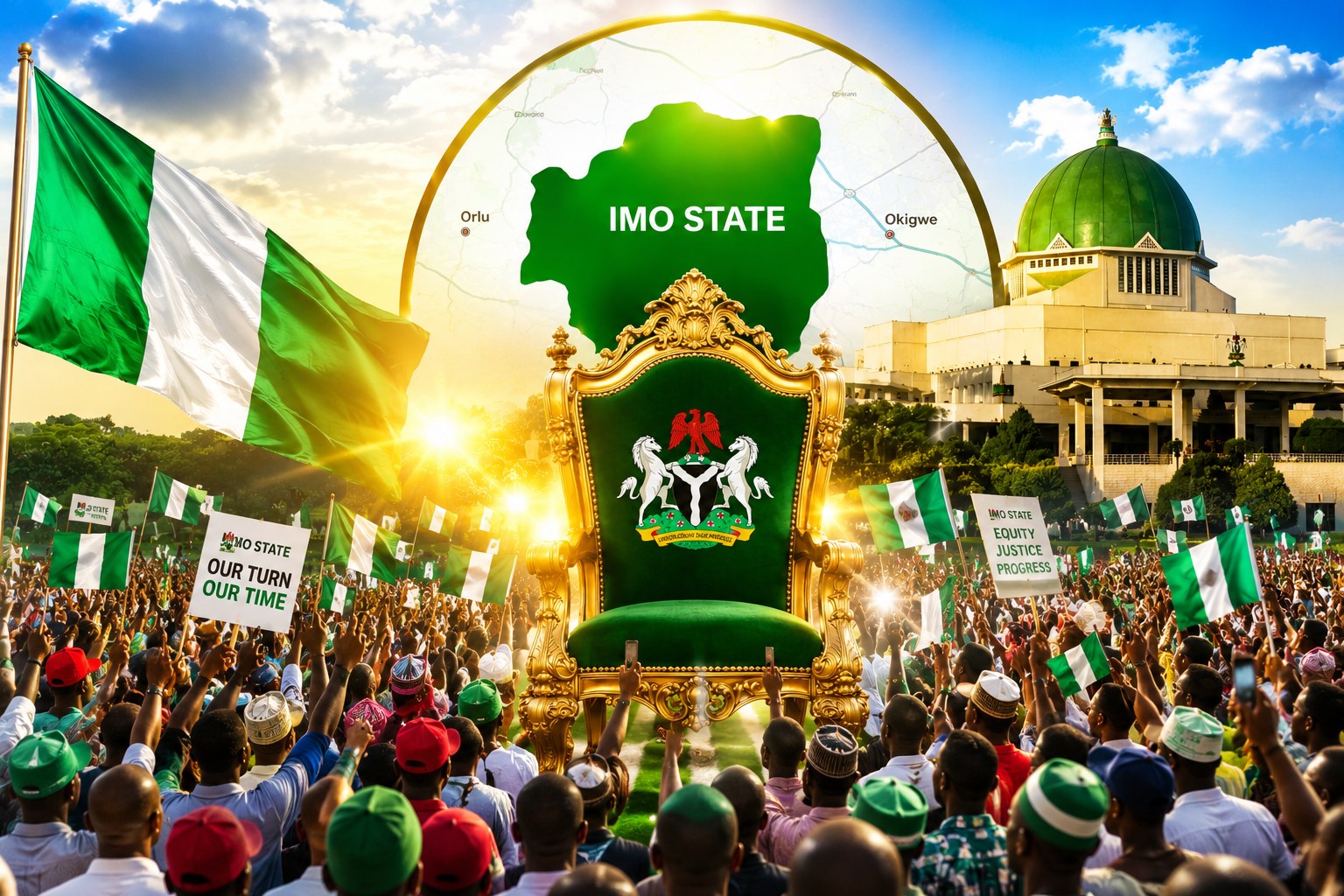
Those who argue that the growing number of governorship aspirants from Owerri zone weakens the zone’s quest for the Imo governorship in 2027 are reading the political tea leaves upside down. This is not Owerri’s moment of weakness. It may well be its finest political moment in decades. For once, the zone is not hiding behind grievances or waiting for a political messiah to emerge from the shadows. It has men of stature willing to step into the sunlight and fight for the crown. Emeka Ihedioha of the ADC, Martin Agbaso of the NDC and Samuel Anyanwu of the PDP have all placed themselves in the contest thus far. Others will join. That is not fragmentation. That is political vitality.
There is a strange misconception that the Charter of Equity requires a zone to produce only one candidate. It does not. Democracy is not a coronation. Even when the political mood favours one zone, aspirants from all three zones retain their constitutional right to seek the office. Since 1999, no zone has ever fled from the governorship contest because another zone appeared politically favoured. Candidates have always emerged. The difference in 2027 is that the political atmosphere seems to be carrying a strong message: after Orlu and Okigwe, it is Owerri’s turn. That message may not be law, but politics is rarely moved by law alone. It is moved by the weight of public sentiment.
The biggest joker, however, sits inside the APC. The ruling party has the structure, the machinery and the advantage of incumbency. Governor Hope Uzodimma therefore occupies the centre of the succession conversation. If he chooses his successor from Owerri zone, it could be the final piece in a political puzzle that has frustrated the zone for years. It would give the ruling party an opportunity to present itself as the vehicle for the implementation of the Charter of Equity. It would also give Owerri what it has long demanded: not sympathy, not promises, but power. For the zone, that would be the icing on the cake.
There are those who believe Abuja will eventually decide who occupies Douglas House. I am not persuaded. Abuja has always mattered in Imo politics, but the governor is not politically naïve. He understands, perhaps more than most, the consequences of allowing external interests to dictate local succession. The political histories of Rochas Okorocha and Ikedi Ohakim offer enough lessons about the dangers of succession battles and federal calculations. Unless Uzodimma’s influence at the national level dramatically weakens, it is difficult to imagine Abuja simply sweeping aside his preferred succession arrangement. At the moment, he appears to have sufficient political capital to protect his political architecture.
This is why the argument that Owerri’s multiple aspirants are destroying its chances sounds, at best, like political superstition. The zone does not lose its right to produce the governor simply because several of its sons want the job. If anything, the presence of strong candidates gives the zone depth. The real battle will be to determine who can consolidate the others, build alliances across the state and convince voters beyond Owerri that the candidate is not merely a product of zoning but a credible governor-in-waiting. The Charter of Equity may open the door. Political competence, coalition-building and electoral strength will determine who walks through it.
Of course, candidates from Orlu and Okigwe have every constitutional right to contest. Ejiike Chukwu and Charles Orie, for instance, cannot be stopped from seeking the governorship merely because they come from Orlu zone. But the constitution gives a candidate the right to contest; it does not guarantee him the mood of the electorate. Politics has its own weather. And the weather in Imo, at least for now, appears to be changing. A candidate from a zone that has already enjoyed the governorship may discover that he is contesting against something more powerful than another candidate, which is, the accumulated sentiment for rotation.
The 2027 election, therefore, should not be reduced to the number of Owerri aspirants on the ballot. The real issue is whether Imo is prepared to translate its political covenant into political action. Owerri has waited, contested and watched power move around it. Now its sons are everywhere, making their case openly. That is not a weakness; it is evidence of renewed confidence. If the APC and Uzodimma eventually settle for an Owerri candidate, the zone could enter the 2027 race with an extraordinary advantage. The road will not be smooth, and politics can overturn the best calculations. But the central fact remains is, Owerri is not asking for a favour. It is asking for its turn. And in 2027, the political winds may finally be blowing in its direction.