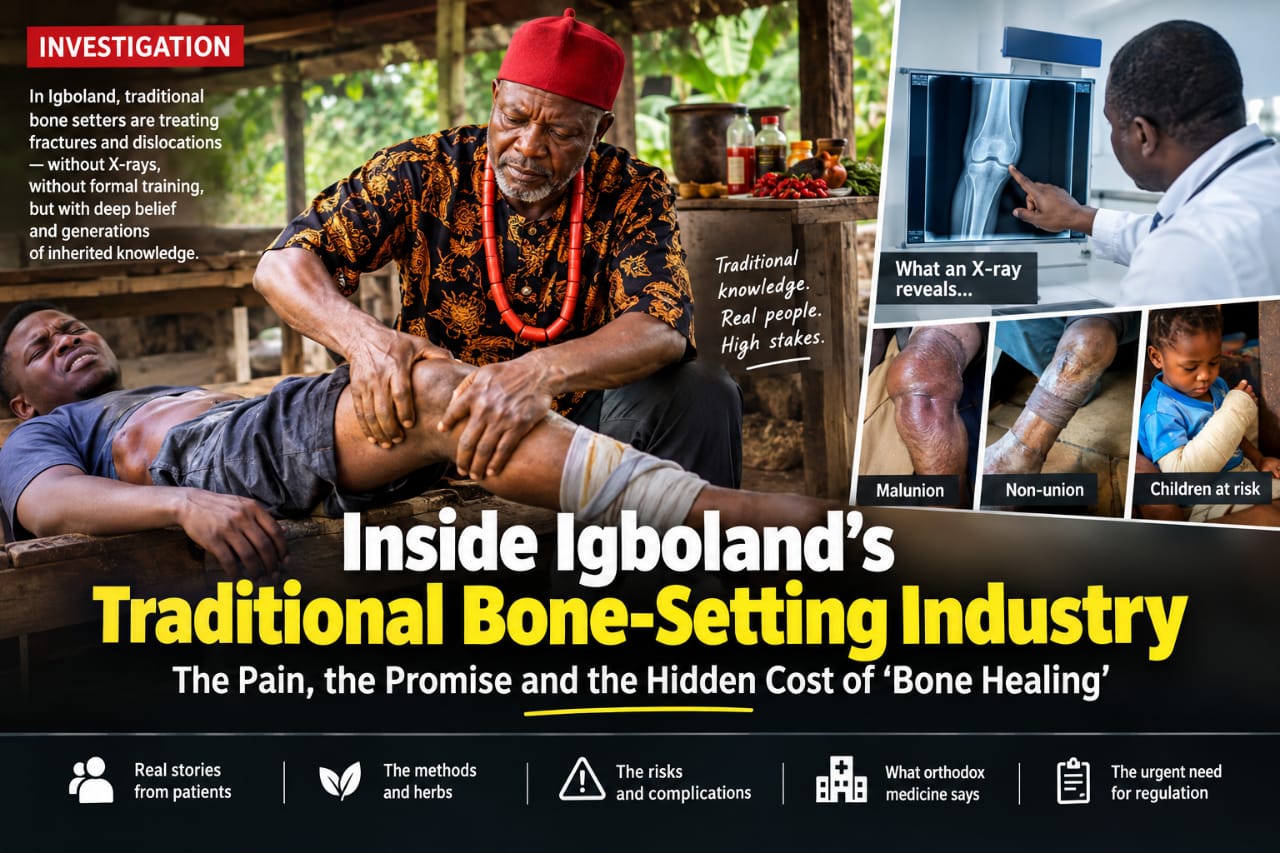
The cries coming from Remigius’ obi are difficult to ignore. A patient shouts as an injured limb is pulled and manipulated. Another groans while relatives watch. Around them, men, women and children wait with heavily bandaged arms and legs. Some sit quietly; others lean on crutches or depend on relatives to move.
The place is an ordinary Igbo family obi, traditionally a gathering point for relatives, elders and members of the kindred. But Remigius, a man in his mid-60s, has turned his into an informal centre for treating fractures and dislocations.
There is no X-ray machine, medical records department or orthopaedic team. Instead, there are herbal preparations, bandages, splints and the hands of the bone setter. Other members of his family participate in the treatment, making the operation appear to function as a family practice built around knowledge Remigius says he inherited from his forefathers.
The scene offers a glimpse into a practice that remains deeply rooted in communities across south-eastern Nigeria. Traditional bone setters continue to attract patients with fractures, dislocations and other injuries resulting from road crashes, falls, football and domestic accidents. Their appeal is easy to understand. They are often closer to patients’ homes, may cost less than hospitals and operate within communities where their skills have been passed from one generation to another.
Some patients also come because relatives or friends recommended them. Others arrive with stories of people who, they believe, recovered from broken bones without surgery.
But beneath that confidence lies a fundamental medical question: how does a patient know that a fractured bone is healing correctly when there is no imaging to show what is happening inside the limb?
At Remigius’ centre, patients told INNONEWS that they were improving. Their physical condition, however, presented a more complicated picture. Some sat with limbs heavily wrapped; others moved cautiously or relied on crutches.
During inquiries by this reporter, who posed as someone seeking treatment for a dislocation, patients generally spoke positively about the treatment. There was, however, no independent medical evidence at the centre available to establish the condition or alignment of their injuries.
Sydney Okechukwu was among them.
“I used to come here with the help of my wife, sometimes with my brother. But after seven months of treatment, I come alone with the help of these crutches,” he said.
Okechukwu was still walking abnormally when he spoke with this reporter, using two crutches for support while his legs were heavily bandaged. His determination to recover was unmistakable. But his case also illustrates the difference between a patient feeling better and a fracture being confirmed to have healed in the correct position.
Obinna Anyanwu, another patient, said he had initially received treatment elsewhere before being referred to Remigius.
“I went somewhere for initial traditional treatment before I was referred here. This injury has kept me jobless, but I believe I am recovering,” he said.
For someone whose livelihood depends on physical activity, prolonged treatment can have consequences beyond the injury. Months away from work can mean lost income and greater dependence on relatives.
Where there is no regular imaging or documented clinical assessment, however, a patient may have limited objective information about whether the underlying fracture or dislocation is healing appropriately.
THE PAIN OF TREATMENT
The most striking feature of treatment at Remigius’ healing centre is the physical manipulation involved.
As the practitioner works on injured limbs, patients cry out, groan and most times shout in pain. Affected areas are pressed, massaged, pulled and manipulated before being wrapped or splinted.
Other members of the family also participate, applying pressure to areas affected by fractures or suspected dislocations.
For some patients, the pain appears to be accepted as part of the treatment. But pain alone cannot establish whether a fracture has been properly aligned. A fracture may remain painful for several reasons, including the injury itself and associated soft-tissue problems. More importantly, physical manipulation cannot provide the same information as imaging about the position of bone fragments, the extent of displacement or whether a joint and surrounding structures have been affected.
That is where orthodox medicine raises a major concern.
Dr Uche Njoku, an Owerri-based orthopaedic doctor, told INNONEWS that the consequences of an improperly assessed fracture can be serious.
“A fracture that eventually joins is not necessarily a successful fracture treatment. If the bone unites in the wrong position, the patient may develop malunion. If it fails to unite, the condition is known as non-union. A limb can become crooked or shortened, a joint can lose movement, and an injury involving nerves or blood vessels can produce lasting disability,” he said.
Njoku said inappropriate manipulation of fractures and dislocations without proper assessment could worsen an injury and contribute to complications involving bones, joints, nerves or blood vessels, particularly where specialist treatment is delayed.
Nigerian medical studies have also reported complications among patients who underwent traditional bone-setting treatment, including malunion, non-union, chronic dislocation, joint stiffness, infection and gangrene.
The concern, however, is not that every traditional bone setter produces poor outcomes. Rather, it is whether there is a reliable mechanism for determining which injuries can safely be managed outside a hospital and which require immediate specialist intervention.
WHEN HEALING IS NOT HEALING
The stakes become higher when children are involved.
A two-year-old cannot reliably tell an orthodox practitioner that a finger is becoming numb or that pain is worsening. A child may also stop crying while an injured bone remains improperly positioned.
Mrs Agnes Osuji, a trader, was among parents who sought traditional treatment for a child. She visited one of the traditional treatment centres with her two-year-old daughter and said she believed the practitioner could help her child.
For families such as Osuji’s, the decision to seek traditional treatment may be influenced by proximity, cost, recommendations from relatives and neighbours, and confidence in an established local practice. It does not necessarily amount to a rejection of hospitals.
But childhood fractures require particular attention because bones are still developing. According to Dr. Njoku, an injury that appears to have settled can later affect movement, growth or the alignment of a limb.
One case encountered in an orthopaedic hospital at Orogwe in Owerri West Local Government Area involved a 17-year-old boy, Festus whose injury had occurred when he was much younger. His family had taken him for traditional treatment and believed the injury had healed. Years later, the condition became a source of concern and required specialist assessment, including imaging.
The case raises a difficult question. How many children treated for fractures outside hospitals are followed until the bone is confirmed to have healed normally, rather than simply until the child stops complaining of pain?
Medical literature provides reason for concern. A recent study of patients who developed complications after traditional bone-setting treatment recorded non-union and malunion among the major complications. Another study reported a high proportion of complications among patients who subsequently underwent radiographic assessment after treatment by traditional bone setters.
Yet traditional practitioners and their supporters argue that the practice should not be judged solely by its failures.
Donald Ekennia, an elder in his 70s, told INNONEWS in Owerri that it was uncommon in the past for traditional bone setters to treat fractures or dislocations without achieving results. He recalled that some practitioners used ofo in their traditional practices and said there was a belief that when ofo was applied during treatment, healing would follow.
Ekennia blamed some poor outcomes associated with traditional bone setting today on what he described as “fake healers”. He could not, however, identify specific practitioners he considered fake or provide an independent method of distinguishing them from practitioners he regarded as genuine.
His argument reflects one of the reasons traditional bone setting remains difficult to assess and regulate. The practice is sustained not simply by ignorance but by community experience, cultural confidence and individual cases that patients regard as successful. But an individual recovery does not establish that a particular technique is safe or effective for every fracture or dislocation.
THE REGULATION GAP
That makes regulation difficult to avoid.
Nigeria has a national policy framework for traditional medicine. The Federal Government’s Traditional Medicine Policy seeks to improve safety, quality assurance, research, regulation and the integration of traditional medicine into the healthcare system. It also recognises the need for stronger legislation, certification and standards for practitioners.
In 2025, the Federal Ministry of Health and Social Welfare introduced a strategic implementation plan and a Code of Ethics and Practice for traditional medicine practitioners as part of efforts to strengthen standardisation, professional conduct, quality assurance and evidence-based practice.
But the existence of a national policy does not necessarily mean that every traditional bone setter operating from a family compound is registered, inspected or monitored. INNONEWS could not establish a comprehensive licensing and inspection system specifically covering traditional bone setters operating across communities in Imo State and the wider South-East.
It was also not possible to establish how many maintain patient records, receive formal training to recognise medical emergencies or have established referral arrangements with orthopaedic hospitals.
That gap has consequences for accountability. If a patient develops a badly healed fracture, who determines whether the treatment contributed to the complication? Who keeps the patient’s records? Who decides when treatment should stop? Who refers the patient to an orthopaedic surgeon? And what happens when treatment continues for months without independent imaging?
Medical researchers have proposed training, certification, regulation and closer collaboration between traditional bone setters and orthodox health professionals as possible ways of reducing complications. The Federal Government’s current policy direction similarly emphasises standards, evidence, research, quality assurance and professional conduct rather than simply eliminating traditional medicine.
The practical objective, therefore, may not necessarily be to erase traditional bone setting from Nigerian communities. It could instead involve identifying practitioners, establishing minimum standards, training them to recognise injuries beyond their competence, encouraging timely referrals and creating mechanisms for monitoring outcomes.
At Remigius’ obi, however, those safeguards were not immediately visible. What was visible were patients waiting for treatment, relatives assisting injured family members, limbs wrapped in bandages and the repeated cries accompanying the manipulation of injured areas.
The patients said they were improving. Some had been undergoing treatment for months. Okechukwu believed he would recover. Anyanwu said he was recovering despite being unable to work.
Their confidence is real. So is the medical uncertainty. The questions raised by the scene at Remigius’ obi extend far beyond one practitioner.
How many people seek traditional bone-setting treatment every year across the South-East? How many recover with properly aligned bones? How many develop malunion or non-union? How many eventually require corrective surgery? How many children live with preventable deformities? And how many patients never make it to an orthopaedic hospital?
Until those questions are answered with reliable data, traditional bone setting will remain suspended between culture and clinical medicine — a practice trusted by many and relied upon by communities, but one in which the difference between healing and simply living with an injury may not always be immediately visible.