There is an old observation about human affairs: sometimes, what we perceive most clearly in another is what we have unconsciously projected onto them ourselves. In politics, this phenomenon is remarkably common. An organization says one thing, its critics interpret it as something entirely different, and before long, the interpretation becomes so entrenched that they begin attacking the speaker for a position the speaker never held.
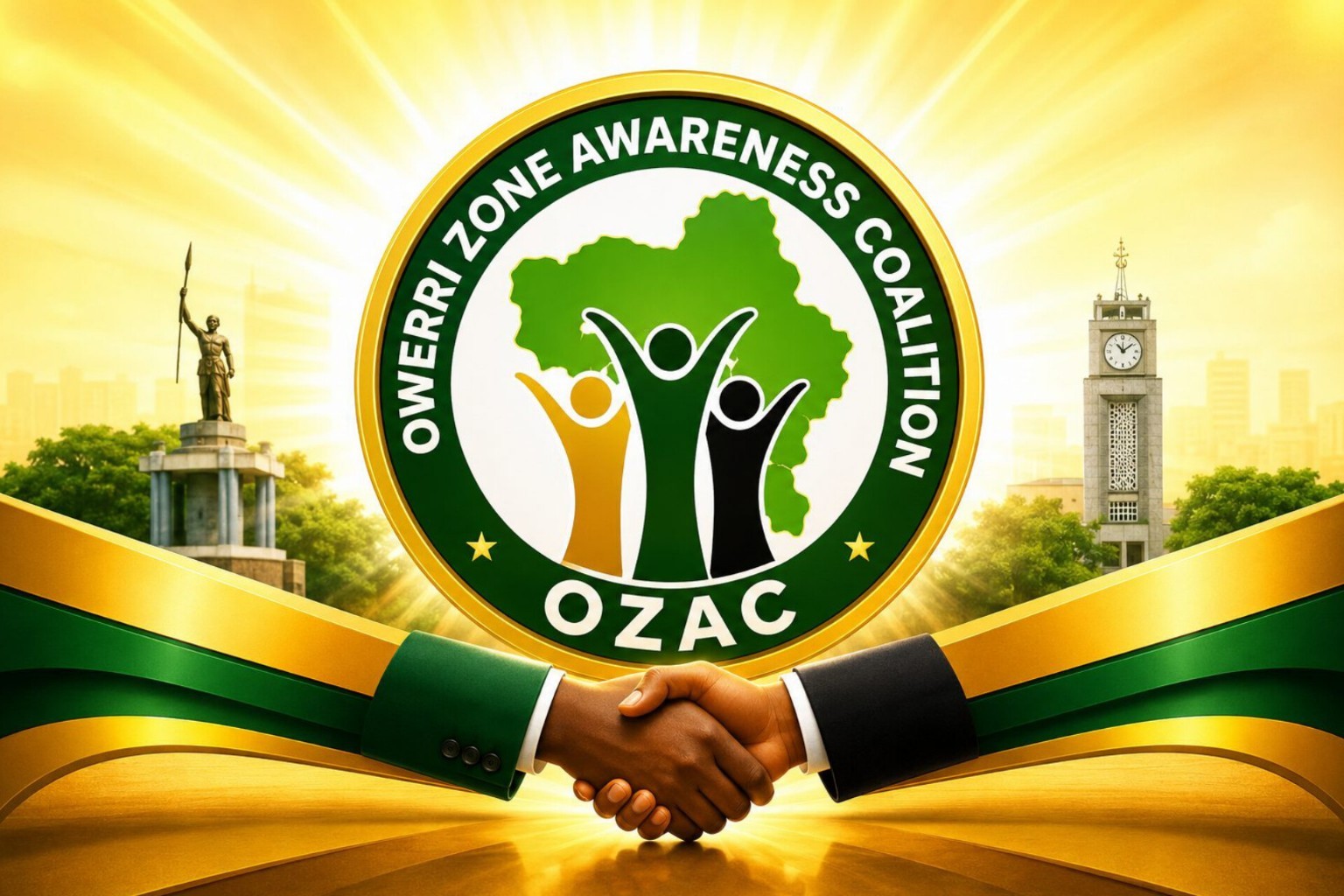
This appears to be the peculiar bind in which the Owerri Zone Awareness Coalition (OZAC) has found itself in its reaction to the recent Orluzurumee press statement on the Imo Charter of Equity.
OZAC accused Orluzurumee, the apex socio-cultural organization of Orlu Zone, of meddling and suggested that it was positioning itself as a “kingmaker” in Imo State politics ahead of 2027. Yet a careful reading of Orluzurumee’s actual statement makes it exceedingly difficult to find the crown OZAC claims Orluzurumee is wearing.
Perhaps the simplest way to describe the situation is this: OZAC appears to have fashioned a crown, placed it on an imaginary head, and is now vigorously protesting that Orluzurumee is wearing it.
That is not an argument against Orluzurumee’s position. It is an argument against a position that Orluzurumee never took.
Orluzurumee did not declare itself the kingmaker of Imo State. It did not claim the authority to dictate who would become Governor of Imo State in 2027. It did not demand that Owerri or Okigwe seek its approval before aspiring to the governorship. Nor did it presume to speak for every political party, community, traditional ruler, political leader or voter in the state.
What Orluzurumee actually articulated was considerably more modest and, indeed, democratic: there would be no premature endorsement; there would be consultation; the political landscape would be carefully assessed; and, when the appropriate time arrives, Orluzurumee would independently determine its position.
There is nothing revolutionary in this. There is nothing inherently arrogant about it. And there is certainly nothing resembling kingmaking in it.
It is simply the position of an organized stakeholder exercising its legitimate right to deliberate before speaking and to decide before endorsing.
A fundamental distinction exists between democratic participation and political subordination. It lies in the difference between being allowed to participate and being allowed to make decisions. Consultation without the freedom to decide is merely a performative exercise. Dialogue without the liberty to reach an independent conclusion ceases to be genuine dialogue. And an alliance in which one party reserves the right to dictate the thoughts of another is not an alliance of equals.
This is why OZAC’s reaction is somewhat perplexing.
Had Orluzurumee declared, “We have already decided who will be Governor of Imo State in 2027, and all others must fall in line,” then the accusation of kingmaking would have had an obvious basis.
But Orluzurumee’s position was, in effect: We will consult, carefully consider the prevailing circumstances and, when the time comes, independently determine our position.
How does one transform the latter into the former without venturing into the realm of imagination?
Political discourse, like all language, carries meaning. Responsible public engagement therefore requires responding to what has actually been said, rather than to what we might have wished the speaker had said.
This point becomes particularly important when the subject is the Charter of Equity.
Equity is more than a political slogan. Properly understood, it embodies fairness, balance and justice. It recognizes that stability among individuals and communities is not achieved through the perpetual dominance of one party, but through the conviction of all parties that the arrangement is fair.
Consequently, equity cannot logically mean that one zone possesses the right to define its own position while another zone is expected to surrender that same right.
If Owerri is permitted to consult, Orlu must also be permitted to consult.
If Okigwe is permitted to negotiate, Orlu must also be permitted to negotiate.
If Owerri is permitted to assess the political landscape, Orlu must equally be permitted to assess it.
And if Owerri and Okigwe are entitled to independently determine their political preferences, Orlu cannot reasonably be described as arrogant merely because it wishes to determine its own position independently.
The principle is simple: what is a right for one is a right for another.
That is the foundation of equality.
This is where the OZAC position appears to contain an interesting contradiction. OZAC warns against any zone or organization attempting to dictate the political future of Imo State. Orluzurumee makes essentially the same point: no single zone should control Imo’s political destiny, and no organization should claim ownership of the collective will of the people.
Yet OZAC has also stated, with considerable certainty, that Owerri and Okigwe Zones will not support any candidate from Orlu Zone in 2027.
That assertion naturally raises a question, not out of antagonism but of principle: who exactly constitutes “Owerri and Okigwe”?
Are they political parties? Every citizen in the two zones? All traditional rulers? Every community? Every political leader? Every aspirant? All civil society organizations? Or every registered voter?
And were all these groups consulted before such a sweeping political position was announced?
If not, OZAC may wish to reconsider the very principle it seeks to teach Orluzurumee.
There is a significant difference between saying, “We have decided our course of action,” and proclaiming, “We know what everyone else will do.”
The former is an expression of self-determination. The latter begins to sound like an assumption of authority over the choices of others.
This is where the self-appointed crown becomes visible.
Orluzurumee has not put on a crown. It has simply kept its thinking cap on.
There is, perhaps, a deeper lesson here about political power. Power is not always expressed through commands. Sometimes it appears in the assumption that one’s own preference is so obviously legitimate that others have no reasonable basis for reaching a different conclusion.
Democracy, however, is built on the recognition that reasonable people and communities can examine the same circumstances and reach different conclusions.
One community may interpret the political landscape one way while another reaches a different conclusion. Neither becomes arrogant merely because it thinks differently.
Indeed, the strength of democracy is not measured by the absence of disagreement but by the ability to accommodate disagreement without turning it into hostility.
Orluzurumee’s position should therefore not be misconstrued as a declaration of war against Owerri or Okigwe, nor as a rejection of the Charter of Equity.
Quite the opposite.
Its emphasis on consultation and independent decision-making is consistent with the principle of equitable coexistence. Equity does not require intellectual capitulation. Justice does not demand political subservience. Fairness does not require one stakeholder to surrender its independent judgment. Consultation is not a conspiracy, and independent thought is not meddling.
There is also a danger in allowing political discourse to degenerate into unnecessary personal attacks and triumphalism.
Political circumstances are dynamic. Alliances change, relationships evolve, interests converge and diverge, leaders rise and fall, candidates become supporters, supporters become candidates, and yesterday’s political certainty can become tomorrow’s historical footnote.
Politics, in this regard, is like a river: it is never precisely the same twice.
That reality should encourage humility.
No zone is permanently indispensable to another, just as no zone is permanently expendable. No political bloc should assume that present advantages guarantee future dominance. And no organization should allow the passions of the moment to destroy relationships that may prove important tomorrow.
Imo State is too interconnected for entrenched political hostility among its senatorial zones.
Orlu, Owerri and Okigwe are not isolated islands. They are parts of one political, cultural and social ecosystem. Their people intermarry, conduct business, worship together and work together. They belong to the same professional bodies, social organizations, churches and institutions. Families cross senatorial boundaries, friendships transcend political differences and businesses operate across the zones every day.
The ballot box may temporarily divide political preferences, but it does not erase kinship.
This is precisely why disagreements over the Charter of Equity should not become a contest of insults.
The Charter should transcend fleeting political disputes. What is required is a moral framework capable of accommodating competing aspirations while preserving the dignity of all three zones.
If equity becomes a weapon for one zone to silence another, its essence is lost.
If justice becomes a tool for humiliation, justice itself is diminished.
And if dialogue requires one side to surrender before participation can begin, then it has ceased to be genuine dialogue.
Orluzurumee therefore has no reason to apologize for having a distinct perspective.
Orlu is an equal constituent of Imo State. It needs no permission to deliberate, no license to consult and no authorization to negotiate. It certainly does not require anyone’s endorsement before determining its position when the political moment arrives.
This is not arrogance.
It is citizenship.
It is participation.
It is democracy.
Democracy would be a peculiar system if citizens were free to vote but not to think, free to speak but not to disagree, or free to participate only when their conclusions conform to another stakeholder’s predetermined position.
Perhaps OZAC’s reaction also provides an opportunity for a broader reflection on pride in public life.
There is a difference between confidence and contempt. There is a difference between conviction and presumption. There is a difference between standing firmly by one’s beliefs and assuming that anyone who disagrees is necessarily foolish, arrogant or intrusive.
Mature leadership understands these distinctions.
A strong political position does not require the loudest voice. A confident organization does not need to belittle another to establish its relevance. And a secure political actor does not need to dismiss another stakeholder simply because that stakeholder refuses to surrender its independent judgment.
It is possible to disagree without being dismissive.
It is possible to be resolute without being aggressive.
It is possible to champion one’s zone without diminishing another.
And it is entirely possible to pursue equity while respecting the autonomy of every stakeholder.
Orluzurumee will continue to do precisely that.
It will protect the legitimate interests and dignity of Orlu Zone. It will respect Owerri. It will respect Okigwe. It will evaluate the Charter of Equity on its merits. It will consult its people. It will consider the realities of the political climate. And when the appropriate moment arrives, it will independently determine its position.
That decision may please some and disappoint others.
Such is the nature of democratic choice.
Whatever that decision may be, however, it should not be mistaken for an attempt to become a “kingmaker.”
There is no crown.
There is no throne.
There is no claim to political dominance.
There is simply an equal stakeholder asserting its equal right to help shape its own political future.
And perhaps that is where the matter should ultimately rest.
OZAC is fully entitled to disagree with Orluzurumee. It is entitled to hold its political views, advocate its position and persuade others.
What it should not do is manufacture a crown, place it on Orluzurumee’s head and then accuse Orluzurumee of wearing it.
That is neither equitable nor sound political reasoning.
It confuses influence with authority, consultation with control, conviction with arrogance, and independence with meddling.
Orluzurumee claims influence only to the extent that its voice resonates with its people. It claims authority only over its own organizational decisions. It seeks no dominion over Owerri or Okigwe and demands no obedience from anyone.
Its request is remarkably straightforward:
Let Owerri think.
Let Okigwe think.
Let Orlu think.
Let each consult.
Let each deliberate.
Let each negotiate.
Let each make its choices.
And let the people, in the end, decide.
For in a democracy, the right to independent thought is not a privilege that one stakeholder bestows upon another. It is an inherent aspect of political dignity.
The Charter of Equity will be stronger, not weaker, when all three zones understand this.
The future of Imo should not be built on the subjugation of one zone by another, nor on the assumption that one constituency has already spoken for everyone.
It should be built on mutual respect, dialogue, fairness and the recognition that no single zone holds a monopoly on Imo State’s political future.
Therefore, there is no crown for Orluzurumee to wear.
No throne for it to occupy.
No kingdom for it to rule.
Only a voice.
Only a conscience.
And the right to consult, deliberate and ultimately make independent decisions when the moment arises.
In a democratic society, that surely cannot be considered an unreasonable request.
Indeed, Orlu claims no crown, only the right to think!
Nnamdi Cos-Ukwuoma is
Publicity Secretary, Orluzurumee
.