The Imo Charter of Equity is perhaps the most ambitious political arrangement to emerge in the state since the return of democracy in 1999. Conceived as a framework to ensure equitable distribution of political power among the three geopolitical zones of Imo State, the charter seeks to address long-standing complaints of marginalization and domination. Its core objective is simple: to guarantee that every zone gets a fair shot at the governorship. In a state where the governorship has often generated tension and suspicion, the idea appears noble, timely, and necessary.


Yet, the Charter of Equity exposes one of the oldest contradictions in democratic governance. It places equity above merit. It prioritizes zonal balancing over open competition. Critics argue that democracy thrives when the best candidate emerges regardless of origin, while zoning limits the pool of potential leaders. They are not entirely wrong. Meritocracy is a vital ingredient of democratic development. However, politics in divided societies is rarely a contest of ideals. It is often a negotiation among competing interests. That is why many countries and plural societies adopt power-sharing arrangements to preserve stability and inclusion.
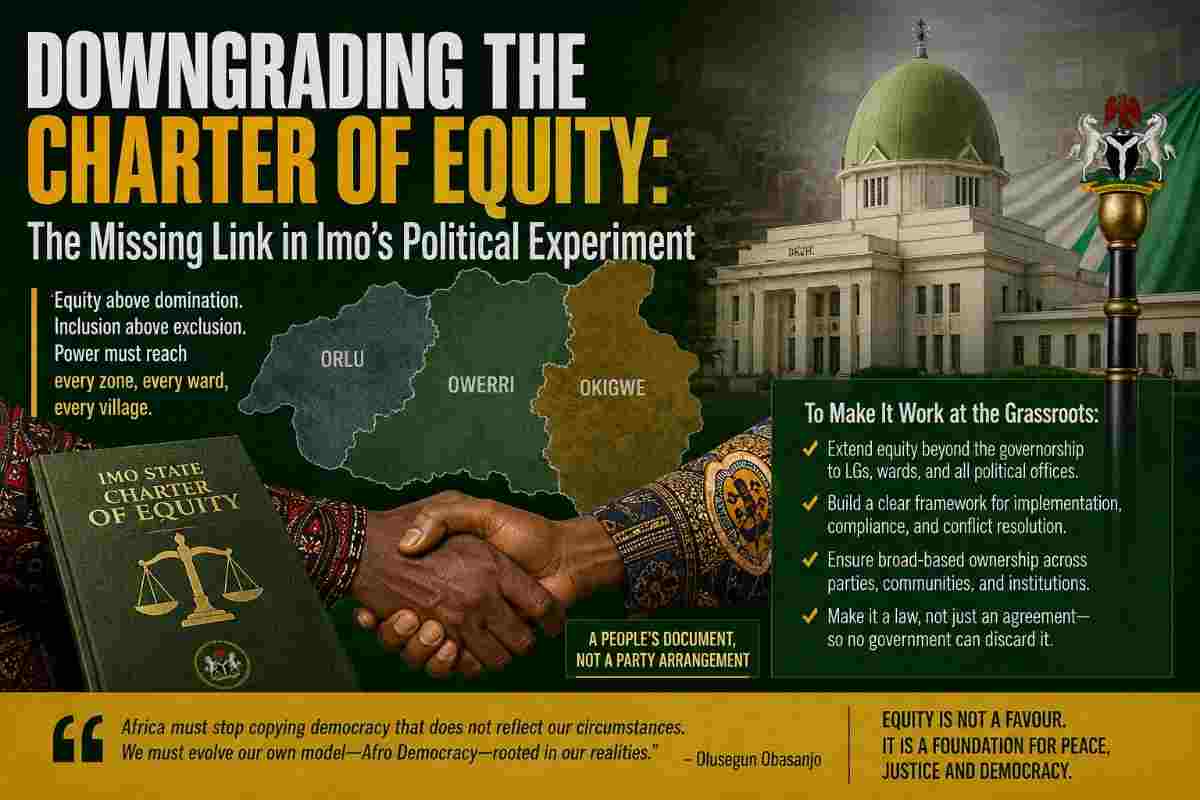
This is where the Imo Charter of Equity finds relevance. It may not fit perfectly into the textbook definition of liberal democracy, but it aligns with the political realities of Imo State. Indeed, former President Olusegun Obasanjo has repeatedly argued that Africa must stop copying democratic models that do not reflect its peculiar circumstances. He maintained that Western liberal democracy was imposed on Africa and does not adequately accommodate African history, culture, and traditions. According to him, the continent should evolve what he described as “Afro Democracy” or a contextual democracy rooted in local realities.
Viewed from that perspective, the Charter of Equity can be seen as an indigenous response to a local challenge. It is an attempt to adapt democratic practice to the realities of Imo State. Other states in the South-East have operated informal or formal power-sharing arrangements for years. Enugu, Ebonyi, and Abia have embraced rotational leadership to maintain political balance. Imo’s charter merely seeks to place structure around what has often been an unwritten understanding.
However, the greatest weakness of the Charter of Equity is that it currently exists largely as a governorship arrangement. That is where the conversation must shift. The charter needs to be downgraded—not weakened, but taken down to the grassroots. Its principles should not stop at Douglas House. They should extend to local government chairmanships, councillorship positions, state assembly representation, and other political offices. Equity that exists only at the top risks becoming an elite pact rather than a people’s covenant.
Critical questions, therefore, arise. How will the charter operate in the 27 local governments? How will wards interpret and implement its provisions? What mechanism will ensure compliance at the grassroots level? Without clear answers, the charter may become another political slogan that sounds attractive in speeches but lacks practical meaning in everyday governance. Any serious framework must provide guidelines, enforcement procedures, and conflict-resolution mechanisms that can withstand changes in government.
Even more troubling is the perception problem surrounding the charter. Many Imolites still view it as an arrangement promoted by the ruling APC rather than a collective state project. Whether that perception is accurate or not is beside the point. Politics is often driven by perception. A document that is seen as partisan will struggle to achieve universal legitimacy. The Charter of Equity must, therefore, transcend party lines if it hopes to endure beyond the tenure of its current champions and advocates.
That is why its origin remains a subject of debate. While the intervention of the Imo State Elders Council may have been well-intentioned, a more inclusive process would have strengthened the charter’s legitimacy. The opposition, civil society groups, traditional institutions, youth organizations, and professional bodies should have been part of its formulation. Better still, the initiative should have originated from the Imo State House of Assembly. Such a process would have provided room for public hearings, legislative debates, and broad-based consultations. The outcome would have been a true people’s document rather than a document associated with a particular political tendency.
The danger ahead is obvious. Political arrangements survive not because they are morally persuasive but because they are institutionally protected. A charter that lacks broad ownership can easily be discarded by a future administration. A non-APC government may see little reason to preserve an arrangement it neither initiated nor endorsed. What is celebrated today as a historic consensus could tomorrow be dismissed as a partisan relic. That risk cannot be ignored.
The future of the Charter of Equity, therefore, depends on one thing: popular ownership. It must move from elite consensus to public consensus. It must be debated in communities, embraced by local governments, understood in villages, and defended by ordinary citizens. Only then can it evolve from a political agreement into a lasting democratic culture. Otherwise, it may achieve its immediate objective and still fail its ultimate test—surviving the politics of tomorrow.