Three years after President Bola Tinubu announced the removal of fuel subsidy during his inaugural speech on May 29, 2023, Nigerians are still asking a troubling question: where is the relief that was promised? While government officials point to improving macroeconomic indicators, millions of citizens continue to battle soaring food prices, crippling transport costs, worsening insecurity and shrinking purchasing power. Across the country, frustration is mounting as economic hardship deepens despite unprecedented revenue inflows to states and local governments.
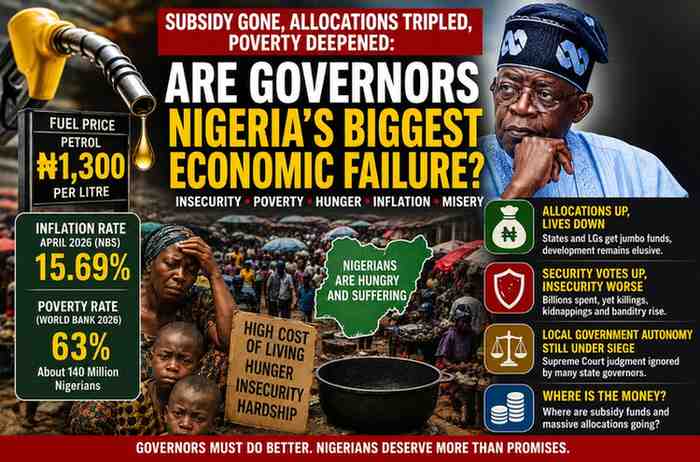
Available economic data presents a mixed picture. Nigeria’s headline inflation rate rose to 15.69 per cent in April 2026, according to the National Bureau of Statistics, with food prices and transportation costs remaining major burdens on households. Although the figure represents a significant decline from the inflation crisis witnessed in 2024 and early 2025, Nigerians say prices of essential goods remain far beyond their reach.
Poverty remains perhaps the most visible indicator of the country’s distress. Recent World Bank assessments estimate that about 63 per cent of Nigerians are living below the poverty line, with roughly 140 million citizens struggling to meet basic needs despite improvements in some macroeconomic indicators. Analysts say economic growth figures mean little when ordinary families are unable to afford food, healthcare and transportation.
The removal of fuel subsidy was defended by the Federal Government as a painful but necessary reform designed to halt fiscal leakages and redirect resources into development. Since then, federal allocations distributed through the Federation Account Allocation Committee (FAAC) have risen sharply, with states receiving significantly more funds than they did before subsidy removal. Yet, outside a handful of states, citizens say there is little evidence that the increased revenues have translated into improved roads, healthcare facilities, schools, agricultural support programmes or meaningful poverty alleviation.
Critics argue that while President Tinubu initiated the reform, governors have failed to utilize the financial windfall to cushion its impact on citizens. The Supreme Court’s landmark judgment granting financial autonomy to local governments was expected to bring governance closer to the people. However, implementation has faced resistance in several states, raising concerns that local government funds remain trapped within state bureaucracies, limiting development at the grassroots.
The contradiction is difficult to ignore. Governors continue to receive substantial security votes every month, yet insecurity remains rampant across several regions. From banditry and kidnappings to communal conflicts and attacks on farmers, vast areas of the country remain unsafe. In many rural communities, fear of violence has forced farmers off their lands, worsening food shortages and contributing to rising prices.
Meanwhile, the Federal Government points to improving external reserves and stronger fiscal indicators as evidence that reforms are working. Nigeria’s gross foreign reserves climbed above $50 billion in early 2026, the highest level recorded in years, while fiscal deficits have narrowed. However, economists warn that strong reserve figures alone do not put food on citizens’ tables or reduce the hardship experienced by millions of households.
Speaking with INNONEWS, public policy analyst Ken Uba said the debate over whether the President or governors should bear greater responsibility must be approached honestly. “The Federal Government deserves scrutiny because it designed and implemented subsidy removal without establishing sufficient social protection mechanisms before the policy took effect. The shock was immediate and severe. Transport fares increased, food prices rose and businesses faced higher operating costs,” he said.
Uba, however, argued that governors cannot escape accountability. “If states are receiving substantially higher allocations today than they received before subsidy removal, citizens have every right to demand results. Most of the services that directly affect daily life—primary healthcare, rural roads, agricultural extension services, markets and local security support—fall within the responsibility of state and local governments. The question Nigerians should ask is simple: where is the money going?”
Also speaking to INNONEWS, Ifeanyi Nwokeji, a member of the newspaper’s Editorial Board, was unsparing in his criticism of state governors. “The evidence is overwhelming. States have received a revenue bonanza since subsidy removal, yet poverty has worsened in many places. Governors cannot continue to blame Abuja for everything while sitting on massive allocations and security votes. If insecurity persists, if schools remain dilapidated, if hospitals are underfunded and if rural communities remain abandoned, then governors must explain what they have done with the resources entrusted to them.”
Nwokeji drew parallels with the defunct Petroleum Trust Fund (PTF) established under the late military ruler, Sani Abacha and managed by Muhammadu Buhari. “Decades later, Nigerians can still point to roads, hospitals and other infrastructure built by the PTF. Today, billions generated from subsidy removal are being shared monthly, yet many communities cannot identify projects that match the scale of those resources. The President must improve economic conditions, but governors must stop acting like spectators. They are central actors in Nigeria’s poverty and insecurity crisis, and history will judge them accordingly.”