The five states of Nigeria’s South-East received approximately ₦11.40 billion in Ecological Fund allocations across three verified periods between 2023 and May 2025, according to data attributed to the National Bureau of Statistics and Federal Account Allocation Committee records.
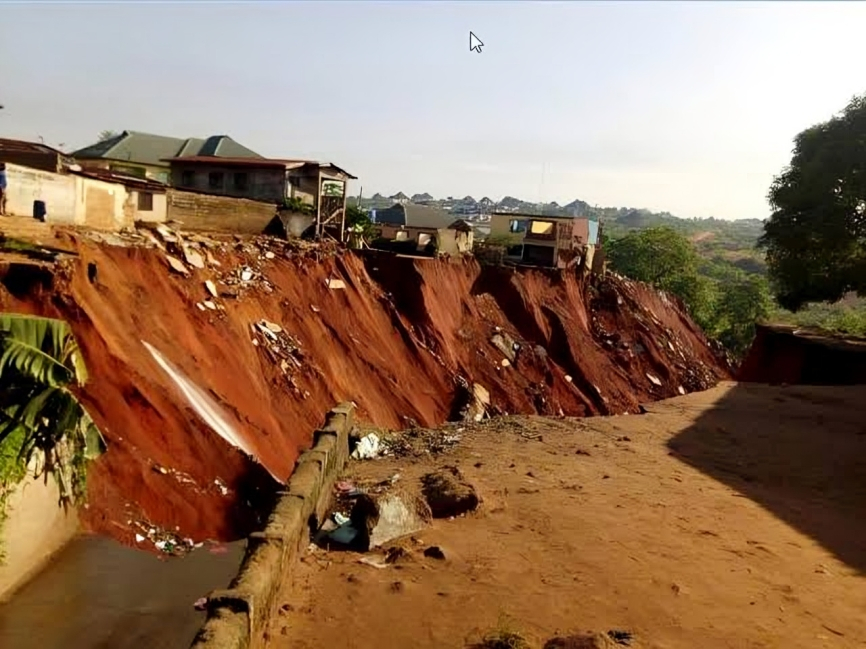
Yet across the region, erosion continues to consume roads, farmland, homes and public infrastructure, raising a question that goes beyond how much was allocated: what exactly has the money achieved on the ground?
₦11.4bn Across Three Periods
The ₦11.40 billion figure is limited to the periods covered by the available data.
It comprises ₦5.047 billion for the full year 2023, ₦3.200 billion between January and June 2024, and ₦3.149 billion between January and May 2025.
Together, the figures amount to ₦11,396,763,406.02, which rounds to ₦11.40 billion.
The figure should not be presented as the total Ecological Fund received by the South-East from January 2023 through August 2026 because comparable, complete data for the entire period are not available.
The Ecological Fund is also not an erosion-only fund. It is designed to address a range of environmental challenges, including erosion, flooding, desertification, oil spills and drought, with allocations made through the federation account.
The fund is overseen by the Ecological Fund Office under the Office of the Secretary to the Government of the Federation.
What the States Received in 2024
During the first half of 2024, the five South-East states received a combined ₦3.20 billion.
Imo received the largest allocation in the zone, with ₦683.14 million, followed by Enugu with ₦660.77 million, Anambra with ₦653.29 million, Abia with ₦615.25 million and Ebonyi with ₦587.82 million.
The South-West received approximately ₦4.03 billion during the same period.
The figures, however, represent allocations from the Ecological Fund and should not automatically be interpreted as money spent exclusively on erosion-control projects.
Another ₦3.15bn in 2025
Between January and May 2025, the South-East received another ₦3.149 billion.
Enugu received ₦815.70 million, Anambra ₦806.46 million, Ebonyi ₦725.64 million, Imo ₦421.65 million and Abia ₦379.75 million.
The South-West received approximately ₦4.59 billion over the same five-month period.
The 2023 allocation was larger still.
The five South-East states received ₦5.047 billion during the year, according to a review of FAAC data from the National Bureau of Statistics and the Office of the Accountant-General of the Federation.
But the financial trail alone does not tell the story.
The 2,300 Gully-Site Figure Needs a Caveat
The region’s erosion crisis is considerably more complicated than a single number suggests.
A widely cited estimate by Deputy Speaker of the House of Representatives Benjamin Kalu puts the number of gully-erosion sites across the five South-East states at about 2,300.
The estimate breaks down to 700 in Anambra, 450 in Imo, 400 in Enugu, 350 in Ebonyi and 300 in Abia.
But there is an important qualification.
Kalu gave the figures in 2021, when he was spokesman of the House of Reps and the estimate has subsequently been repeated, including in a 2026 investigation by The Guardian.
It is therefore not a newly conducted 2026 region-wide census.
That distinction matters. Anambra Alone Has More Than 1,000 Active Sites
Anambra’s more recent figures illustrate why the 2,300 estimate should be treated cautiously.
The Anambra State Government reported in August 2026 that the state had more than 1,000 active erosion sites.
The state’s Ministry of Environment had also reported in April 2026 that more than 1,000 gully sites were affecting about 160 communities.
That does not necessarily mean the earlier estimate was wrong. Rather, it demonstrates that erosion inventories have been compiled at different times and under different methodologies.
The available records therefore do not support presenting 2,300 as the definitive number of active erosion sites in the South-East in 2026.
What they do establish is that the crisis remains enormous.
Billions Allocated, But Interventions Exist
The evidence does not support a simplistic conclusion that ecological funding produced no results.
There is documented evidence of federal intervention across the region.
The Nigeria Erosion and Watershed Management Project (NEWMAP), a World Bank-assisted programme, records extensive intervention in several South-East communities.
In Anambra, NEWMAP says it undertook work on 13 sites.
A 2024 academic study based on NEWMAP records similarly identified 13 major gully sites that had been remedied, covering more than 32.5 kilometres of gully corridors and directly affecting a reported 163,209 people.
But the existence of 13 major intervention sites should not be mistaken for the resolution of Anambra’s wider erosion crisis.
The state has more than 1,000 reported active sites.
Imo: Documented NEWMAP Interventions
Imo also has a substantial record of NEWMAP intervention.
Official project records identify Eziala-Obizi in Ezinihitte Mbaise; Iyiuzo-Ihioma-Ogberuru in Orlu; Umueshi-Amanto in Ideato South; Umuturu-Ezemazu-Urualla in Ideato North; Umunumo-Ibeafor in Ehime Mbano; and Umueze Obazu-Mbieri in Mbaitoli among the state’s intervention sites.
There are also specific NEWMAP records for Eziala-Obizi and Iyiuzo-Ihioma-Ogberuru.
The Urualla intervention was formally flagged off in 2019 after erosion had damaged farmland and threatened homes and community infrastructure.
The records also include resettlement and compensation-related documentation for affected communities.
Ebonyi Has Its Own Intervention Trail
Ebonyi is similarly covered by documented NEWMAP interventions.
Official records show intervention at Odunukwe-Nkaliki/Hatchery Road, Iyi-Okwu International Market, Iyi-Udele and Ebyia River.
A 2020 project update reported that the works had reached about 70 per cent at the time and documented compensation and resettlement activities involving affected residents.
There is also a NEWMAP resettlement action plan for Nguzu Edda, another community affected by erosion.
Enugu Records a Completed Federal Project
Enugu provides another important piece of evidence.
The Ecological Project Office’s project-status records list Erosion Control Repair Works at Enugu Obinagu, Udi Local Government Area.
The project, whose contract was dated April 2019, was recorded as 100 per cent completed and commissioned.
That is significant.
It establishes that at least some federal ecological interventions were completed rather than existing only as budgetary allocations or project proposals.
But completion of individual projects has not eliminated the wider erosion problem.
Research on the Ibeziako erosion site in Nsukka, for instance, used field measurements, satellite imagery and other evidence to document continuing gully expansion and soil loss.
Abia Requires a More Careful Reading
Abia presents perhaps the clearest illustration of why different categories of intervention should not be lumped together.
NEWMAP records confirm major interventions at Amuzukwu-Ibeku and Amuda-Achara Isuochi, both of which were commissioned in 2022.
But not every erosion-control project in the state should automatically be described as a NEWMAP or Ecological Fund project.
Ovom Road and Ogbor Hill in Aba, for example, have featured in more recent erosion-control and road-rehabilitation works documented by the Federal Ministry of Information. The available evidence, however, does not justify simply categorising those projects as NEWMAP interventions.
Abiriba Raises Another Question
Abiriba provides another example of an intervention that requires closer scrutiny.
A federal project identified as ERGP20204386 covers drainage and road-improvement works associated with erosion at Abiriba.
Government budget documentation listed the project, while an Eyemark record updated in June 2026 described it as not started and showed an appropriation of about ₦27.66 million for 2024.
At the same time, erosion remained serious enough for residents and officials to demand intervention.
In 2025, state officials inspected the Ugwu Ogbu erosion site in Amogudu, while community representatives sought government action over several erosion flashpoints.
In January 2026, Governor Alex Otti reportedly directed authorities to assess and intervene in identified erosion-prone areas.
The evidence therefore points to a more complicated picture than either government success or government failure.
The Spending Figures Also Need Context
The allocation figures become even more instructive when placed beside state-level environmental expenditure.
During the first six months of 2024, NBS-derived figures showed that Anambra received about ₦653.29 million in Ecological Fund allocations, while its reported environmental expenditure was about ₦56.42 million.
Enugu received ₦660.77 million while reported environmental expenditure was about ₦99.47 million.
Ebonyi received ₦587.82 million against approximately ₦275 million in reported environmental expenditure.
But these expenditure figures include personnel, overhead and capital components.
They should therefore not be interpreted as pure erosion-control spending.
That distinction is critical.
An Ecological Fund allocation to a state is not automatically the same thing as money spent on a particular gully. Likewise, an expenditure classified under environmental protection does not necessarily mean the entire amount went into erosion control.
So Where Did the Money Go? This is where the accountability question begins.
A proper audit of the South-East’s ecological response would need to go beyond the amount shared through FAAC.
It would have to identify, project by project:
- the amount approved;
- the amount released;
- the implementing agency;
- the project location;
- the contractor;
- the contract date;
- the completion status;
- the amount actually paid; and
- the present physical condition of the intervention.
It would also need to distinguish between state-level Ecological Fund allocations, direct federal interventions by the Ecological Project Office, NEWMAP projects, Federal Ministry of Environment projects and state-funded interventions.
Without that reconciliation, it would be premature to allege that the ₦11.40 billion was diverted or that it produced no results.
But it would be equally misleading to suggest that the existence of completed projects settles the matter.
The Bigger Question
The evidence points to a stubborn reality.
Billions of naira have been allocated for ecological purposes while erosion continues to threaten communities across the South-East.
There have been interventions.
Some have been completed.
Some communities have received remediation, compensation and resettlement support.
Yet serious erosion remains widespread, while other documented intervention needs remain outstanding.
The question, therefore, is not simply whether the South-East has received ecological funding.
The records establish that it has.
The harder question is whether the scale, location, quality and durability of the interventions correspond to the scale of the environmental damage.
That question cannot be answered by FAAC allocation figures alone.
It requires a project-by-project reconciliation of public money with physical results on the ground.
The Investigation That Needs to Follow
A serious accountability exercise would ask every relevant agency and state government to produce the complete documentary trail.
How much was allocated?
How much was released?
Where was it spent?
Which projects were completed?
Which are still ongoing?
Which were abandoned?
Which have deteriorated after completion?
And, most importantly, what do the communities that received the interventions say about their present condition?
Until those questions are answered with project-level records and physical verification, the ₦11.40 billion remains only the beginning of the story.
The more consequential story is what happened to the money after it was allocated — and whether the people living beside the region’s expanding gullies can see its impact.