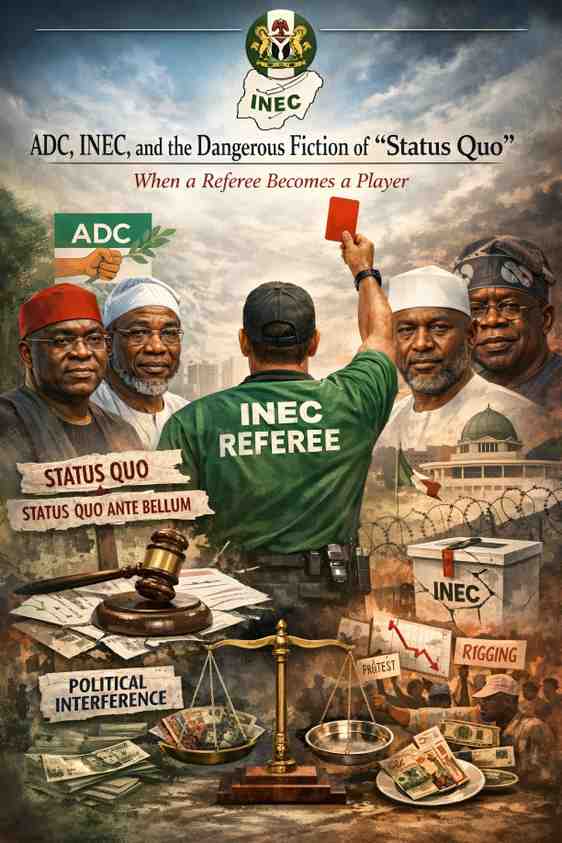
The unfolding institutional skirmish between the African Democratic Congress (ADC) and the Independent National Electoral Commission (INEC) is not just another bureaucratic disagreement; it is a revealing case study in how democratic guardrails can be bent—subtly at first, then brazenly. At the heart of the matter lies INEC’s controversial derecognition of certain party actors, including David Mark and Rauf Aregbesola, in a manner that suggests not regulatory oversight but regulatory overreach. What should have been a procedural clarification has morphed into a constitutional gray zone.
To understand the intellectual sleight of hand at play, one must interrogate the misuse—deliberate or otherwise—of the concept of status quo. More precisely, this crisis calls for a distinction between status quo ante (the state of affairs before a specific event) and status quo ante bellum (the state of affairs before a conflict). INEC appears to be invoking a distorted version of the former to justify its actions, when in reality, its conduct disrupts the latter. By intervening in the internal dynamics of a political party under the guise of “restoring order,” the Commission has, in effect, inserted itself into the conflict rather than arbitrating it.
The documentary trail—especially the resignation letter tied to Nafiu Bala—complicates, if not outright collapses, the revisionist claims now being entertained in some quarters. Bala, who has publicly suggested he never relinquished his position, is contradicted by the very administrative record submitted to INEC. The letter clearly indicates that he resigned as Deputy National Chairman (Government & Legislation), and that resignation was duly received, processed, and accepted by the party’s National Working Committee in accordance with both party constitution and the Electoral Act.
This is not a trivial detail; it is dispositive. In institutional law and organizational governance, resignation—once tendered, acknowledged, and accepted—creates a vacancy that triggers succession mechanisms. Bala, having exited the stage through a formal process, is estopped from retroactively disowning that exit simply because subsequent developments are politically inconvenient. One cannot approbate and reprobate at the same time.
Now, if we apply status quo ante bellum—the state of affairs before the conflict—it logically takes us back to a period when Ralph Nwosu presided as National Chairman and Nafiu Bala functioned as Deputy National Chairman. But that historical snapshot is precisely what has been altered by their own voluntary actions. Their resignations effectively dissolved that configuration, creating the institutional vacuum that paved the way for the emergence of the David Mark-led structure. In other words, the “pre-conflict” order no longer exists because its principal actors dismantled it themselves.
What INEC appears to be doing, however, is attempting to resurrect a political arrangement that has already been extinguished by due process. This is where the Commission’s reasoning becomes untenable. You cannot invoke status quo ante bellum while ignoring the fact that the antecedent condition has been legally and procedurally invalidated. To do so is to engage in institutional fiction—an imaginative reconstruction of a reality that no longer has legal standing.
The implication is stark: Nafiu Bala, having resigned, lacks the locus standi to challenge or puncture the ascension of the Mark leadership. His claim is not just weak; it is structurally defective. Authority in party hierarchy flows from recognized positions, and once that position is vacated, the authority evaporates with it. Any attempt to reassert influence from that vacated pedestal is, at best, politically symbolic and, at worst, legally void.
The political subtext, again, is difficult to ignore. In a system where the ruling party, the All Progressives Congress (APC), controls an overwhelming majority of state governments and enjoys legislative dominance at the National Assembly, one would expect a certain confidence. Yet what we see is a governing establishment that appears unsettled by even a modest opposition realignment. It raises a fundamental question: why would a party so dominant behave as though it is under existential threat?
It is not as though the ADC coalition represents an unblemished alternative. Many of its principal actors are veterans of Nigeria’s convoluted political history, with their own share of complicity in the nation’s governance failures. But politics, especially in transitional democracies, often thrives on contrast rather than purity. By faltering in governance and appearing to instrumentalize institutions, the APC has inadvertently elevated its challengers into vehicles of protest.
Three years into President Bola Tinubu’s administration, the macroeconomic narrative—anchored on reforms such as subsidy removal and exchange rate harmonization—has yet to translate into palpable relief for the average citizen. Inflation remains punishing, food insecurity is widespread, and real incomes have eroded significantly. The technocratic optimism of policy elites stands in sharp contrast to the lived reality of Nigerians navigating daily hardship.
This widening gap between statistical progress and social experience is what gives opposition platforms their traction. Hunger is a more persuasive mobilizer than policy briefs. Despair travels faster than economic projections. And when institutions like INEC appear to tilt, even slightly, the credibility deficit deepens.
Ultimately, the misuse of status quo ante—and the misapplication of status quo ante bellum—is emblematic of a broader institutional drift. Rules are being interpreted not as fixed guardrails but as elastic instruments. INEC’s mandate is to ensure fairness, not to curate political outcomes. By overreaching, it risks eroding the very legitimacy it is meant to safeguard.
Nigeria stands, once again, at the edge of a familiar precipice. When process is subordinated to expediency and institutions blur the line between neutrality and participation, democracy becomes fragile. And when a referee starts rewriting the rules mid-game, the eventual loser is not just one party—it is the entire system.
Onukwugha, a political analyst, writes from Lagos