As political parties prepare for primaries ahead of the general elections in 2027, the consensus method is emerging as the preferred mode of candidate selection, particularly within the ruling All Progressives Congress (APC). Yet, a significant legal hurdle threatens to complicate what has traditionally been a smoother path to nomination.
Across party lines, insiders say the growing reliance on consensus is less about ideological alignment and more about managing internal fractures, curbing costly delegate battles, and projecting unity ahead of the general elections.
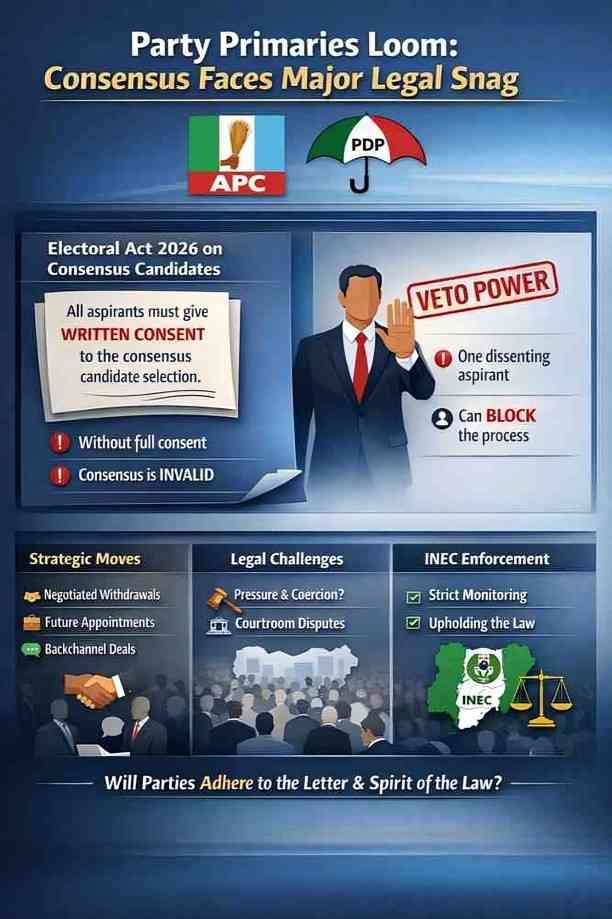
The Electoral Act 2026 formally recognises consensus as a legitimate avenue for candidate nomination. However, the law imposes a crucial safeguard: all aspirants must provide written consent to the adoption of consensus after a candidate has been agreed upon. This requirement marks a sharp departure from past practices, where party leaders could effectively impose candidates under the guise of consensus, often triggering post-primary litigation and deep resentment.
Under the current framework, the refusal of even a single aspirant to endorse the consensus candidate exposes the process to legal scrutiny. Parties are legally obligated to revert to direct primaries if unanimity is not achieved, making the consensus route both delicate and high-stakes. Legal experts note that this provision is designed to reinforce internal democracy, ensuring that no candidate is imposed arbitrarily on party members.
For the APC, this legal nuance presents both opportunity and constraint. Consensus offers a pathway to avoid bruising intra-party battles, but it also demands careful negotiation to secure buy-in from all aspirants, many of whom have invested heavily in campaign machinery and political capital.
Opposition parties, including the Peoples Democratic Party (PDP), are also weighing consensus in choosing candidates.
Analysts warn that while the written consent clause strengthens party democracy on paper, its practical enforcement by the Independent National Electoral Commission (INEC) will be the ultimate test. Questions remain about whether consent obtained under political pressure can truly be voluntary—a scenario that could result in prolonged litigation and disruption of party primaries.
As the primaries approach, the real challenge for parties will be navigating this delicate balance: adhering to the letter and spirit of the law while managing political ambitions, maintaining party unity, and avoiding post-primary legal entanglements.
In effect, the Electoral Act 2026 has transformed the once-flexible consensus method into a legally constrained tool, one that can only succeed with meticulous negotiation, transparent processes, and genuine aspirant buy-in. For parties aiming to project unity without courting litigation, the stakes have never been higher.