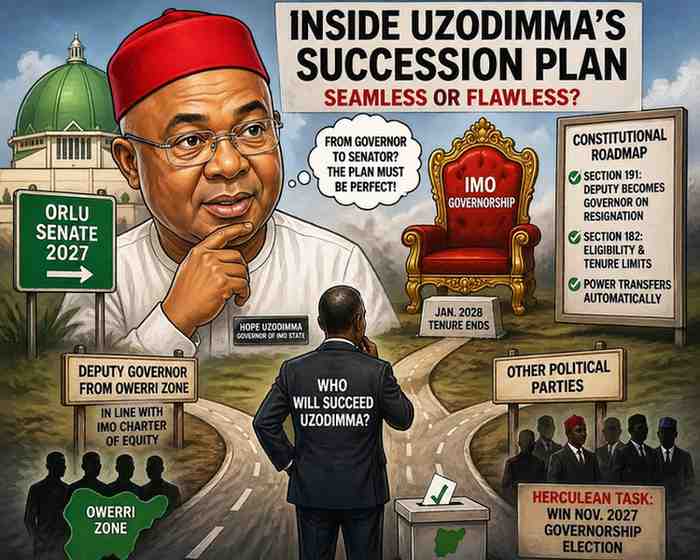
Governor Hope Uzodimma may still have time left on the clock, but politics in Imo State has already moved to the next question: who takes over when he leaves office? With sustained speculation that the governor is weighing a return to the Nigerian Senate through the Orlu Senatorial District seat in 2027, succession planning has quietly become the most consequential conversation in the state.
Mr Uzodimma has the profile of a politician returning to familiar terrain. Before becoming governor, he represented Orlu Zone in the Senate for two terms. That record, combined with incumbency influence and deep control of the All Progressives Congress structure in Imo, means he would likely begin as the dominant force for the APC senatorial ticket if he chooses to run. In practical terms, few party actors would be expected to stand in his way.
The Constitution presents no obstacle to that ambition. A sitting governor is not barred from contesting a senatorial election while still in office. The key constitutional issue is assumption of another office, not participation in an election for it. In effect, Mr Uzodimma can remain governor, contest for Senate, win the election, and continue in office until the point he must resign to take up his new mandate.
When the National Assembly election holds in early 2027 and he wins, he would still remain governor until the inauguration of the 11th Assembly, expected in June 2027. That creates a crucial transition window — several months in which he would still control executive power while shaping the architecture of succession.
That is why attention has shifted to the office of deputy governor. Under Mr Uzodimma, Imo has had two deputies — Placid Njoku and the incumbent Chinyere Ekomaru. With reports that another appointment may come before June 2027, the deputy governorship has become the hinge on which the state’s next leadership may emerge from.
The legal pathway is straightforward. Section 191 of the 1999 Constitution provides that where the office of deputy governor becomes vacant, the governor shall nominate a replacement subject to confirmation by the House of Assembly. If such a vacancy exists, Mr Uzodimma has the constitutional authority to fill it.
Many in Imo believe any new deputy governor would likely come from Owerri Zone. The argument is not merely arithmetic; it is tied to the state’s new power-sharing understanding known as the Imo Charter of Equity. Though not a constitutional instrument, the charter has become a powerful political doctrine advocating rotation of governorship among the three zones — Orlu, Owerri and Okigwe. Since Mr Uzodimma is from Orlu, proponents insist the next governor should emerge from Owerri Zone.
If an Owerri son or daughter is appointed deputy governor ahead of June 2027, the office would become more than ceremonial. It would be a training ground for executive transition — time to understand the bureaucracy, build statewide recognition and gain the aura of inevitability that often surrounds an endorsed successor.
The constitutional trigger is resignation. Once Mr Uzodimma vacates office to proceed to the Senate, Section 191 states clearly that the deputy governor shall hold the office of governor. No fresh election. No interim arrangement. No ambiguity. Power transfers automatically. That means whoever occupies the deputy governorship at that moment would become governor and complete the unexpired tenure ending in January 2028.
That brief incumbency could prove decisive. The successor-governor would enter the November 11, 2027 governorship election with the advantages of office: visibility, control of state machinery, political momentum and the symbolism of incumbency. Yet incumbency alone may not guarantee victory.
The governor’s successor is also expected to face a herculean political task at the polls. The 2027 governorship race is likely to attract fierce competition from rival political parties, many of which are expected to field strong and marketable candidates. That means whoever emerges through the succession route must still prove electoral strength before the voters, navigate public scrutiny and withstand what could become one of Imo’s most competitive contests in recent years.
Some have raised the issue of repeated oath-taking. But constitutional law is concerned less with the number of times a person is sworn in and more with tenure limits and electoral mandates. Goodluck Jonathan offers a useful precedent. He took oath as Vice President in 2007, later assumed presidential authority after the death of Umaru Musa Yar’Adua, and subsequently took oath again after winning election as president. The constitutional system recognised each stage because they arose from distinct legal circumstances.
The same logic applies in Imo. A deputy governor may take oath as deputy, later as substantive governor upon vacancy, and still be sworn in again if elected in his or her own right. The Constitution does not prohibit multiple oaths. What it regulates is the number of times a person is elected and the tenure lawfully spent in office.
Several scenarios therefore remain open. Mr Uzodimma may retain the current deputy governor and allow succession to occur naturally. He also has the option to install a new deputy from Owerri Zone in line with the Charter of Equity. Or he may preserve constitutional continuity while backing a separate governorship candidate. But among these options, the most seamless path appears to be the one that aligns law, timing and zoning sentiment.
In the end, the succession puzzle in Imo may not be solved in the courtroom but in political calibration. The Constitution already provides the roadmap. The APC structure provides the vehicle. The Charter of Equity supplies the moral argument. If those three forces converge, Mr Uzodimma could leave office for the Senate and still midwife one of the smoothest transfers of power the state has seen in years. But for whoever inherits that pathway, the final hurdle would still be the electorate.