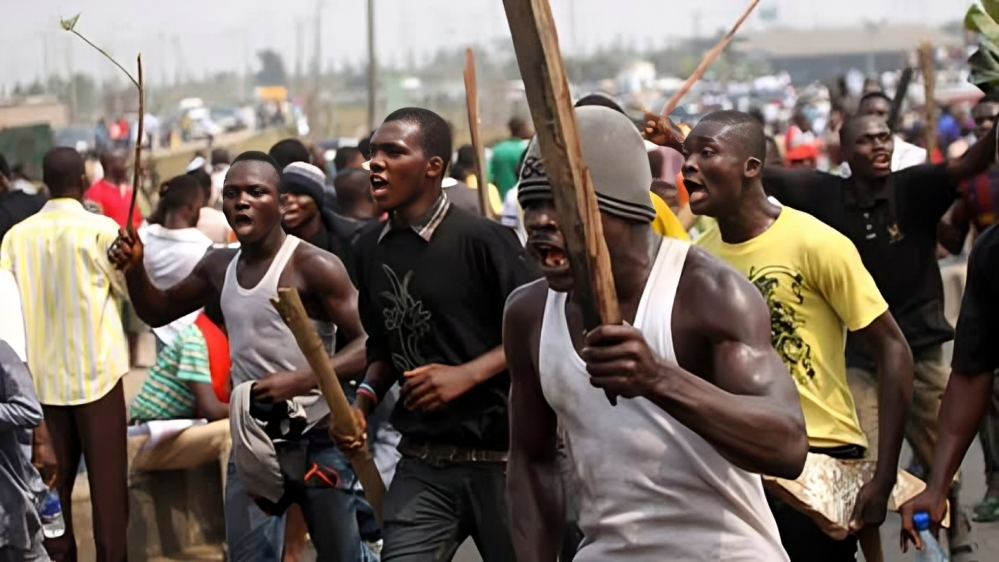
Some incidents are too revealing to be dismissed as mere incidents. Peter Obi’s aborted visit to Yelwata in Benue State is one of them. Obi, the Nigeria Democratic Congress presidential candidate, said he wanted to travel to the community to commiserate with families traumatised by the killings there, only for his convoy to be confronted by youths who reportedly blocked the road and ordered him to turn back. Obi alleged that the youths were sponsored; the Benue State Government denied the allegation and said it was unaware of his visit. The police say the circumstances are being investigated. Fine. Let the investigation establish who sent whom. But Nigerians should not allow that narrower question to distract them from the more terrifying one: what kind of democracy permits a mob to become an impromptu immigration officer on a Nigerian highway, deciding which Nigerian citizen may enter which Nigerian community?
The Nigerian Constitution does not recognise roadside sovereignty. It does not say that a sufficiently agitated crowd can suspend another citizen’s constitutional rights by shouting loudly, brandishing sticks or blocking a public road. Section 41 guarantees citizens freedom of movement throughout Nigeria, subject to restrictions imposed by law. That means Obi does not need the political approval of a mob to travel to Yelwata, just as a northerner does not need the permission of southern youths to enter the South, or a southerner the permission of northern youths to enter the North. If Obi’s visit required security coordination, the proper institution to provide it was the state—not a collection of self-appointed gatekeepers. And if there was a legitimate legal reason to restrict the visit, that restriction had to come through law, not through the muscular improvisations of men who apparently discovered, at least for a few minutes, that a highway could become their personal border crossing.
The Benue Government’s defence—that it was not informed about Obi’s visit and therefore could not guarantee adequate security—may answer an administrative question, but it does not answer the democratic one. Even if Obi had arrived without a single minute of prior notice, what follows? That civilians acquire the authority to blockade the road? That political supporters can determine who is permitted to enter a community? That every presidential candidate must first obtain a bureaucratic blessing before exercising a constitutional right? No serious democracy can survive that logic. The proper response to an unannounced visit is communication, security deployment and, where necessary, lawful intervention. It is not to outsource the authority of the state to a crowd and then explain, after the crowd has succeeded, why the crowd had reasons to be angry. That inversion of responsibility is precisely how institutional authority gradually becomes ceremonial while street power becomes operational.
Obi was right not to force his way through. Presidential ambition is not a licence to turn a tense roadside encounter into a bloodbath. But prudence should not be confused with capitulation. There is a dangerous political lesson in allowing intimidation to achieve its objective: if you successfully intimidate somebody today, you teach yourself that intimidation works tomorrow. A crowd that discovers it can turn back a presidential candidate has learnt something about power, regardless of who allegedly organised it. And that is why the episode should alarm every Nigerian who still believes elections are supposed to be contests of persuasion rather than contests of territorial intimidation. Political thuggery rarely announces itself at the beginning as an attempt to destroy democracy. It starts more modestly: stop this man from entering here; prevent that rally from holding there; frighten these supporters; scatter that meeting; create the impression that certain communities belong exclusively to certain political interests. Eventually, citizens begin to internalise the concept of fear.
This is also why the incident must not be reduced to the familiar Nigerian theatre of competing accusations, denials and partisan outrage. Whether the youths acted spontaneously or were mobilised by political interests is important and should be established. But the constitutional principle is larger than the identity of the sponsors. Nobody should be permitted to turn public roads into political checkpoints. Nobody should be permitted to convert communal anger into a licence for intimidation. And in in nobody—whether in government or opposition—should answer political thuggery with counter-thuggery. That would merely replace one form of lawlessness with another and transform democracy into a competition between rival street armies. The legitimate monopoly of coercive power belongs to the state, and that power must be exercised according to law, impartially and transparently.
What happened in Benue should therefore be treated as a warning rather than another item for partisan consumption on social media. Nigeria is approaching another consequential election, and the most dangerous preparation for electoral violence is not always the buying of weapons or the training of gangs. Sometimes it is the normalisation of small acts of intimidation until everybody begins to regard them as ordinary politics. A candidate is stopped here. A rally is disrupted there. Supporters are threatened somewhere else. A community is quietly declared a political no-go area. Each incident appears too small to provoke national alarm. Collectively, however, they construct a country in which political rights depend increasingly on who has the capacity to intimidate whom. Peter Obi may have been turned back on a Benue highway. But the real thing being tested was whether constitutional citizenship can be turned back by political muscle. If the answer becomes yes, then the question is no longer who will win the 2027 election. The question is who, exactly, owns Nigeria.