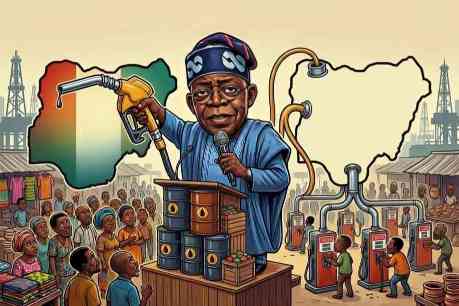
There is something fundamentally wrong with a country where petrol sells for ₦1,400 or ₦1,500 a litre and the government appears to have no urgent answer to the pain this imposes on citizens. Nigerians have watched fuel prices rise from one level to another, and each increase pushes up the cost of transportation, food, services and virtually everything else. Yet elsewhere in the world, governments confronted with rising energy costs have taken measures to cushion their citizens from the shock. The OECD says governments across 49 economies had introduced more than 240 energy-support measures by September 2026. The question Nigerians should therefore be asking is simple: if other governments can act, why can’t Nigeria?
Look at what happened in some of these countries. Japan subsidised fuel wholesalers to keep the average gasoline price around ¥170 per litre, while South Korea introduced a ceiling on wholesale prices for gasoline and diesel. Norway removed its road-usage tax on petrol and diesel for part of 2026, while Spain reduced fuel-related taxes and cut VAT on fuels, producing estimated pump-price relief of about €0.30 to €0.40 per litre. Greece introduced a diesel subsidy, while Hungary imposed maximum prices for petrol and diesel. These countries are not all oil producers, yet their governments recognised that when fuel prices become a serious threat to household survival, government cannot simply stand aside and watch.
Nigeria’s position is even more difficult to explain. We produce crude oil and have refineries, including the Dangote refinery, now producing substantial quantities of petrol. We also have the Petroleum Industry Act, which provides the framework for a market-based petroleum sector. The NMDPRA has cited Section 205(1) of the PIA in explaining that petroleum prices operate under unrestricted market conditions and are not fixed by the regulator. But who says the law cannot be reviewed, or that the National Assembly cannot amend a provision that has become incompatible with the realities Nigerians are facing?
The removal of petrol subsidy was presented to Nigerians as a painful but necessary reform. Nigerians were told that the enormous resources previously spent on subsidy would become available for education, healthcare, infrastructure and other areas of national development. Yet three years later, millions of Nigerians are still asking where the relief is, while the IMF said in June 2026 that poverty had reached 63 percent at Nigeria’s national poverty line. The World Bank has also estimated that more than 60 percent of Nigerians were living below the national poverty line in 2025. These are not abstract statistics, but figures reflected in families struggling with transport fares, food costs, school expenses and other basic needs.
This is where the government’s argument about macroeconomic stability meets the hard reality of the Nigerian street. The Tinubu administration can point to improvements in some macroeconomic indicators, and the IMF has acknowledged progress in macroeconomic stability and resilience. But what does macroeconomic stability mean to a worker whose salary disappears before the month ends because transportation and food have become prohibitively expensive? What does lower inflation mean to a family that still cannot afford the quantity of food it bought two years ago? An economy cannot be judged solely by improving macroeconomic numbers while millions of citizens continue to experience severe pressure in their daily lives.
The government’s own explanation makes the situation more troubling. In July 2026, Finance Minister Taiwo Oyedele said the financial gains from fuel-subsidy removal and foreign-exchange reforms had been largely absorbed by debt servicing and increased government expenditure. That admission raises an unavoidable question: if subsidy savings are being consumed elsewhere while Nigerians are paying enormously more for petrol, where exactly is the dividend of this sacrifice? Nigeria’s total public debt stood at ₦166.79 trillion as of June 30, 2026, according to the Debt Management Office. Nigerians were asked to endure the removal of subsidy because government said the country could no longer afford it, yet they are still carrying much of the burden while government continues to borrow.
This is why the Federal Government needs to reconsider its approach to petrol pricing. This is not an argument for returning blindly to the old subsidy regime, but for recognising that economic policy must ultimately address the conditions under which citizens live. If governments in Japan, South Korea, Spain, Norway, Greece and other countries can introduce measures to cushion consumers from energy shocks, Nigeria should also examine what measures are legally and economically possible. The PIA should not be treated as untouchable if a provision is preventing an effective response to extraordinary national hardship. Nigerians have made enormous sacrifices for these reforms, and they are entitled to see equally determined efforts to reduce the burden those reforms have placed on their daily lives.