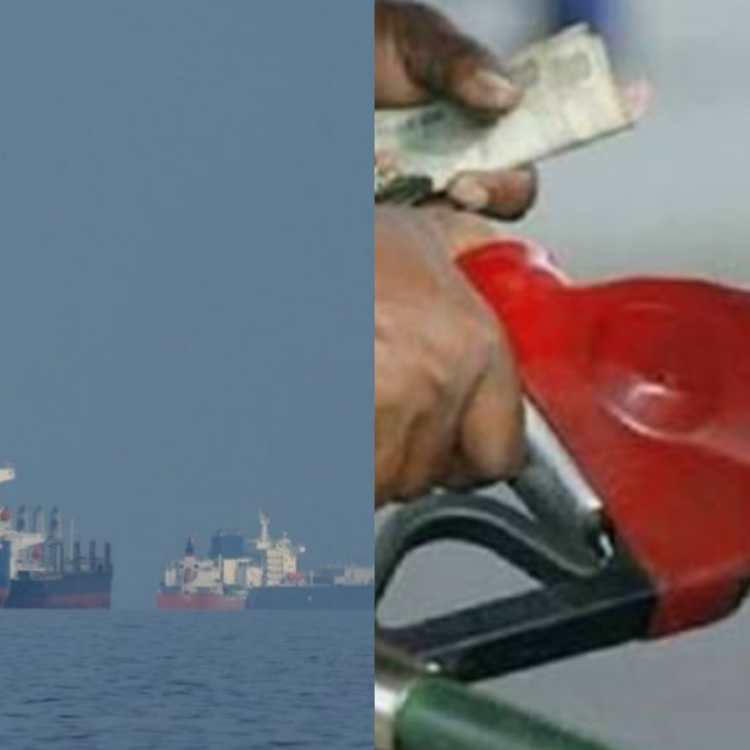
In Nigeria’s endlessly inventive theatre of official explanations, a new script has emerged to justify the latest brutal surge in petrol prices—from about ₦879 to roughly ₦1,350 per litre. The storyline is simple, almost too convenient: the war involving the United States, Israel, and Iran has destabilized global oil markets, Iran may close the Strait of Hormuz, and therefore Nigerians must brace for astronomical fuel prices. It is a narrative repeated with such casual confidence that one would think Nigeria were a fuel-starved desert economy rather than one of the world’s largest crude oil producers. Yet when this narrative is subjected to the slightest analytical scrutiny, it collapses under the weight of its own contradictions.
First, some geography and energy economics for the benefit of the propagandists. The Strait of Hormuz is a narrow maritime corridor between Iran and Oman through which roughly one-fifth of the world’s oil supply passes. It is a strategic chokepoint for global energy trade. When tensions rise in that region, markets panic because vessels carrying crude from the Persian Gulf could be disrupted. But here is the uncomfortable question Nigerian officials refuse to answer: why should disruption in the Persian Gulf dictate the retail price of petrol in a country sitting on vast oil reserves?
Nigeria is not Malta. Nigeria is not Haiti. Nigeria is not a small island that imports crude oil because it has none of its own. Nigeria pumps millions of barrels of crude oil every day. The country’s 2025 fiscal plan alone assumed oil production of about 2.06 million barrels per day and a benchmark price of $75 per barrel. If anything, higher global oil prices should increase Nigeria’s earnings, not impoverish its citizens at the fuel pump.
In fact, the logic of the oil market suggests the opposite of what Nigerians are being told. When geopolitical tensions drive crude prices upward—say toward $100 per barrel or beyond—oil-exporting countries benefit through higher revenues. Nigeria should theoretically earn more foreign exchange, strengthen its fiscal position, and even stabilize its currency. Yet Nigerians are instead told that global tensions are a justification for steep domestic petrol prices. Something in this arithmetic does not reconcile.
The defenders of this narrative will quickly pivot to another explanation: Nigeria imports refined petroleum products, and therefore international market disruptions affect local pump prices. Fair enough. But that explanation itself exposes another uncomfortable truth. If Nigeria still depends heavily on imported refined fuel despite decades of oil wealth, then the problem is structural mismanagement, not the Strait of Hormuz.
Remember the grand promise when the fuel subsidy was removed. Nigerians were told that ending subsidy would unleash a new era of domestic refining, reduce dependence on imports, and allow market forces to determine fair prices. The Dangote refinery, celebrated as Africa’s largest refining project, was supposed to mark the end of Nigeria’s humiliating reliance on foreign refineries. The policy logic was clear: once refining happens locally, the volatility of distant shipping routes—whether Hormuz or the Suez Canal—should become less relevant.
Yet today Nigerians are told that a maritime chokepoint thousands of kilometres away is responsible for a sudden leap in pump prices. This raises a troubling possibility. Either Nigeria still imports most of the crude used for domestic refining—which would be absurd for an oil-rich country—or the explanation itself is simply a convenient smokescreen.
There is another puzzle that authorities carefully avoid addressing: how exactly do seized oil vessels in the Strait of Hormuz affect Nigerian petrol pricing? Those tankers mostly carry Middle Eastern crude destined for Asia, Europe, or North America. Nigeria’s crude exports flow primarily from West Africa to global buyers, not through that strait. The logistical connection between Iranian naval tensions and the price of petrol in Owerri, Kano, or Port Harcourt is therefore tenuous at best.
The real question Nigerians should ask is not about Iran but about transparency in Nigeria’s downstream petroleum market. Who determines the import price of petrol? What exchange rate assumptions are used? What margins are allowed for marketers, transporters, and depot owners? And why do pump prices often rise far beyond the level justified by crude oil movements?
The fiscal context makes the narrative even more suspicious. Nigeria’s economic planning already assumes far lower oil prices than what global tensions currently produce. The 2026 federal budget, for instance, is built around an oil benchmark of about $64.85 per barrel. If the international price rises to around $100 per barrel because of geopolitical shocks, Nigeria theoretically earns far more revenue than anticipated. That should be a fiscal windfall, not a national catastrophe.
In other words, the ongoing Middle East tensions should, at least in theory, improve Nigeria’s balance sheet. More revenue from crude exports means more foreign exchange inflow, potentially stronger reserves, and improved fiscal breathing room. Yet Nigerians are instead confronted with punishing fuel prices and told the crisis is external.
Which leads to a disturbing but unavoidable conclusion. Either policymakers are misrepresenting the economics of the fuel market, or powerful actors within the petroleum value chain are exploiting global tensions to justify price increases that have little to do with actual supply costs.
Nigeria’s petroleum sector has long been haunted by opaque pricing formulas, rent-seeking cartels, and bureaucratic secrecy. From the subsidy era to the so-called deregulation era, the same pattern persists: prices rise swiftly, explanations arrive later, and accountability never arrives at all.
The tragedy is that Nigerians are expected to accept these explanations without interrogation. A country blessed with crude oil abundance is told that events in distant waters determine whether its citizens can afford transportation or electricity. It is a narrative so contradictory that it insults basic intelligence.
At some point, the government—or those managing the downstream sector—must provide a coherent answer. Because when fuel prices jump from ₦879 to ₦1,350 and the only explanation offered is a distant geopolitical conflict, Nigerians are justified in suspecting that the real story lies not in the Strait of Hormuz but somewhere within the corridors of power in Abuja.