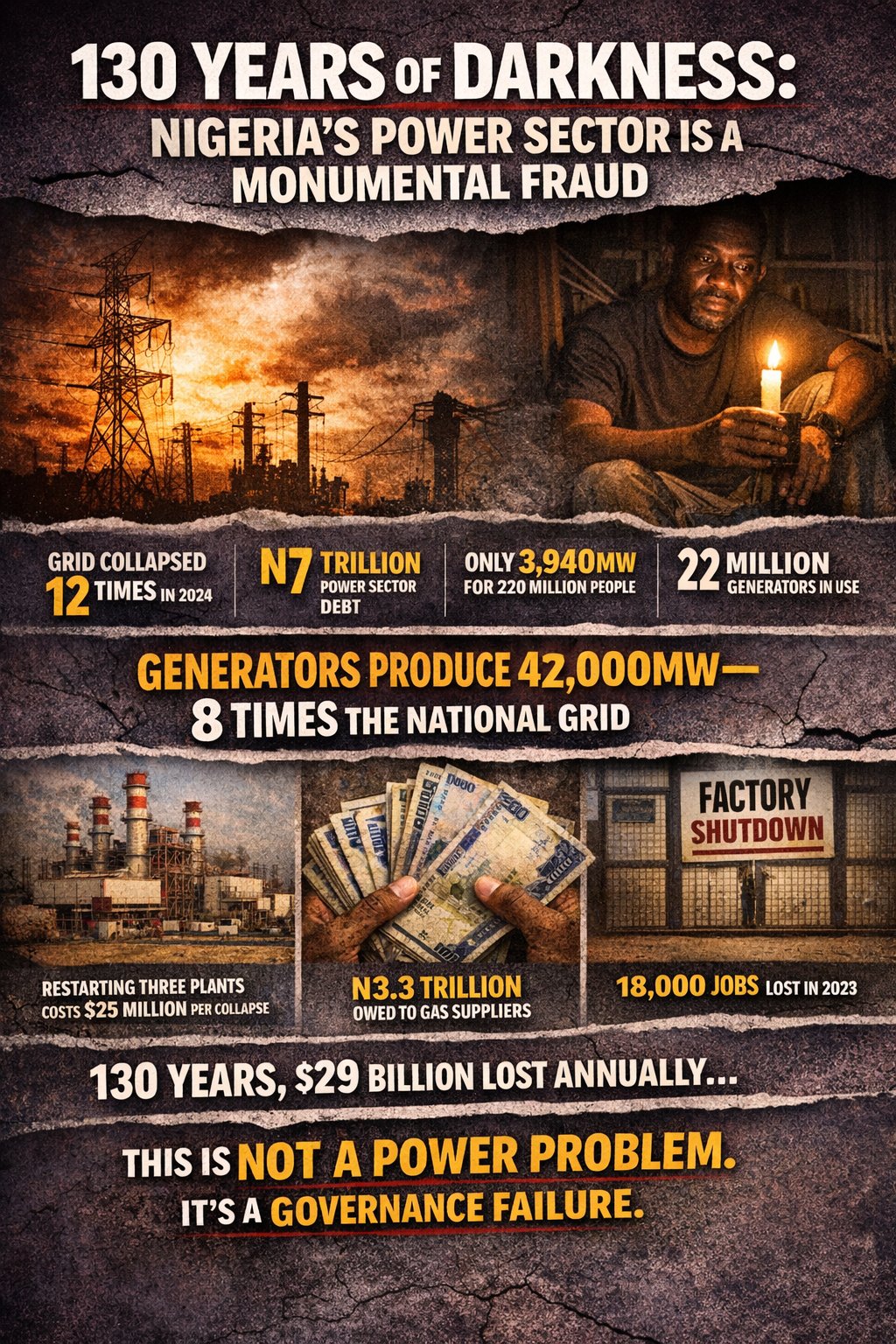
For a country that began generating electricity in 1896, Nigeria’s power sector in 2026 is not just an embarrassment—it is a scandal of historic proportions. One hundred and thirty years later, Africa’s supposed giant is crawling in the dark, managing a pathetic 3,940 megawatts for over 220 million people. This is not underperformance. It is a complete collapse of responsibility.
Let’s be brutally clear: Nigeria is not suffering from a lack of potential. It is suffering from chronic, systemic failure. South Africa delivers over 48,000MW for just 60 million people. Egypt has built about 59,000MW for 110 million. Nigeria, with its bloated population and endless political rhetoric, cannot reliably push beyond 5,000MW on a good day. That gap is not a coincidence—it is the direct result of decades of incompetence.
Even more insulting is the fact that Nigeria supposedly has about 13,000MW installed capacity. But more than half of it lies idle, stranded by a transmission system that cannot carry the load. Infrastructure built with billions of naira simply sits there, useless. It is like owning a fleet of aircraft with no runways.
And when the system does attempt to function, it collapses—literally. Twelve grid collapses in 2024 alone. Over 222 collapses between 2010 and 2022. That is one failure every three weeks for over a decade. No serious country operates like this. This is not instability; it is dysfunction institutionalized.
Each collapse is not just a technical failure—it is a financial hemorrhage. Restarting only three power plants—Azura, Delta, and Shiroro—costs about $25 million per incident. That’s roughly N42.5 billion burnt each time the grid crashes. Multiply that across repeated collapses, and you begin to understand the scale of economic sabotage dressed up as governance.
Then comes the debt crisis strangling the sector. As of February 2026, Nigeria’s power sector owes generation companies N6.8 trillion, increasing by N200 billion monthly. By now, it is knocking on N7 trillion. Of that, N3.3 trillion is owed to gas suppliers—who have responded in the only rational way possible: they have cut supply.
The consequences are immediate and devastating. Thermal plants require 1,630 million standard cubic feet of gas daily. They are receiving barely 692 million—less than half. So when the lights go out, as they routinely do, it is not an accident. It is the predictable outcome of a government that refuses to pay its bills.
In response, the government approved N4 trillion in bonds to rescue the sector. But only N590 billion has been issued. The rest remains trapped in bureaucratic limbo, while the grid continues its downward spiral. Nigerians are not waiting for solutions anymore—they are being abandoned to improvise survival.
And survive they have—at a staggering cost. Nigerians now spend about $14 billion annually on generators. Twenty-two million units scattered across homes and businesses, producing a combined 42,000MW. That is eight times what the national grid delivers. Let that sink in: private citizens have built more power capacity than the Nigerian state.
This madness is crushing the real economy. In 2023, 767 manufacturing firms shut down. Another 335 are hanging by a thread. Tens of thousands of jobs have vanished. In just the first half of 2025, manufacturers spent N676.6 billion on alternative power—and still couldn’t stay afloat. This is how economies die: not with a bang, but with a generator humming in every corner.
The damage is not abstract. The World Bank estimates that power outages cost Nigeria $29 billion annually—about 10% of GDP. That is an entire chunk of the economy wiped out every year because the lights cannot stay on. No amount of policy spin can hide that level of destruction.
And yet, the most damning part of this story is that other countries have solved the same problem Nigeria keeps “studying.” Egypt added 14,000MW in six years using Siemens technology. Ghana fixed its crisis within four years and now exports electricity. South Africa, after years of instability, has gone 300 consecutive days without load shedding because it finally chose to act decisively.
Nigeria, on the other hand, has been “reforming” the power sector since 1999. Billions of dollars in loans. Endless policy papers. Grand announcements. Zero accountability. The grid still cannot handle 5,000MW without collapsing. At this point, it is no longer a technical failure—it is willful negligence.
Let’s stop pretending this is a power problem. It is a governance problem—pure and simple. A country that cannot provide electricity after 130 years of trying is not struggling; it is failing. And until those responsible are held to account, Nigeria will remain exactly what it is today: a nation powered by generators, and crippled by its own leadership.