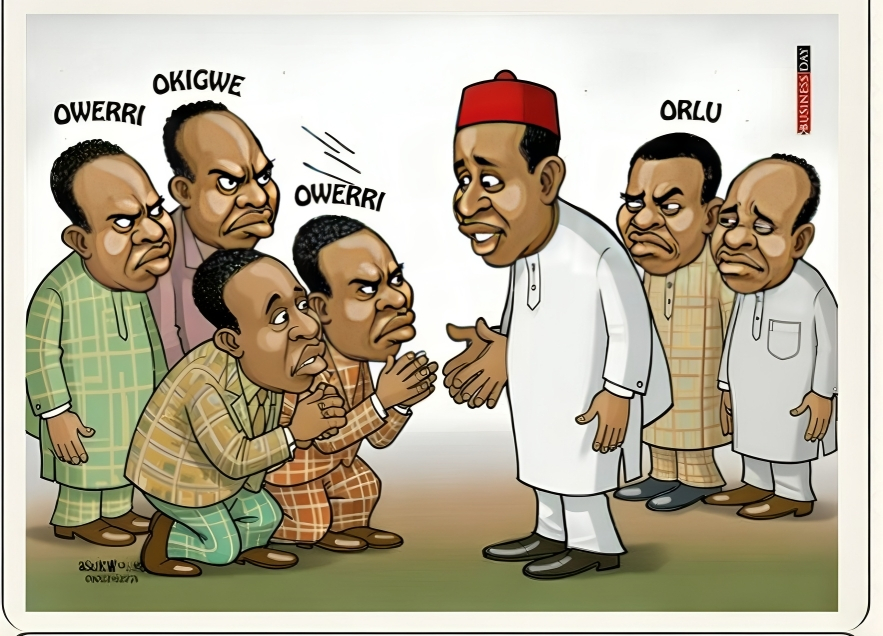
The recent meeting between leaders of Owerri Zone and their counterparts in Okigwe Zone has exposed a fundamental question that remains unsettled in Imo State’s 2027 governorship equation: what exactly does the Charter of Equity mean, and whose turn comes first?


The meeting, held last week as part of Owerri Zone’s ongoing consultations with Okigwe Zone, was described by the participants as the first in a series of engagements expected to continue. But beneath the language of consultation and goodwill, one thing has become increasingly clear. There are noticeable fault lines in the interpretation of the Charter. That is the truth of the matter.
Owerri Zone is mounting a strong campaign for the implementation of the Charter of Equity, arguing that history and fairness now demand that it produce the next governor. The argument has considerable moral force. Since 1999, Orlu has produced Achike Udenwa, Rochas Okorocha and Hope Uzodimma, while Okigwe produced Ikedi Ohakim and Owerri produced Emeka Ihedioha, whose tenure lasted barely seven months. Owerri can therefore make a compelling case for a full opportunity. But a compelling case is not the same as a political settlement.
There is no quarrel between Owerri and Okigwe. There is, however, a disagreement over precedence. Okigwe does not appear ready to simply endorse Owerri’s bid and shelve its own ambition. As Nze Fidelis Ozichukwu put it, there is a need for “equity in the Charter.” That is the crux of the matter. Who determines the meaning of equity, and which zone takes the first shot?
The recent consultation has brought that question into sharper focus. If the Charter had completely settled the succession question, Owerri leaders would not need to travel to Okigwe to seek its support. The fact that consultations are necessary is itself evidence that the Charter requires political interpretation and agreement. That does not make the Charter irrelevant. Political agreements often depend on persuasion, negotiation and mutual acceptance rather than legal compulsion .It does, however, show that Owerri’s campaign cannot succeed through moral argument alone if Okigwe remains unconvinced about the order of succession.
The road to 2027 will therefore require more than invoking the Charter. The zones must still agree on what its implementation means. And that brings us to the Charter’s fundamental weakness.It is not law.Why did its originators not push for it to become a legal instrument? Why did the House of Assembly not give it legislative backing?
These questions matter because the House is the constitutional institution through which the people make laws. Without legislative force, the Charter cannot compel an aspirant to withdraw, prevent a political party from choosing a candidate from any zone, or stop an eligible citizen from contesting. Its political influence may be considerable, but its ability to enforce compliance remains limited by its status as a political understanding rather than a statutory instrument.
The 2027 race proves the point. Aspirants from Owerri, Okigwe and Orlu are already positioning themselves for the governorship. The Charter has not stopped them from declaring their ambitions, mobilising supporters or seeking their parties’ nominations. Its existence has therefore not eliminated competition among the three zones, even though it continues to shape the political argument about succession.I t may carry political influence, but it cannot enforce compliance against individuals who choose to exercise their constitutional rights. That distinction between political influence and legal authority is central to understanding the Charter’s strengths as well as its limitations.
There is an even deeper problem. Some Imolites outside the APC regard the Charter as an APC arrangement rather than a universally negotiated compact. In their view, it was conceived within a particular political setting without passing through the broader furnace of popular endorsement, including the House of Assembly, which represents the people. That perception deserves attention, even if one disagrees with it. I am not writing from sentiment, and I am not dismissing the Charter. I believe it can work. And I believe it can work for the good of Imo people. But its success depends on political acceptance.
A framework designed to regulate succession cannot permanently depend on one party’s interpretation of it. If the Charter is to endure beyond particular political actors and administrations, it must acquire broader ownership, credibility and acceptance. That is where Owerri’s campaign meets political reality. Owerri has a powerful moral argument. But Okigwe has its own historical interpretation of equity and cannot simply be expected to abandon that position without persuasion.
Both can believe in the Charter and still disagree over its application. Both can support rotation and still disagree over who should take the first shot. That is precisely why the recent consultation matters. The meeting has not produced a final agreement. But the fact that both sides have agreed to continue talking is significant. The absence of an agreement on the central question of precedence also reveals the difficulty that lies ahead. Owerri wants the Charter implemented in a manner that gives it the next opportunity, while Okigwe appears unwilling to surrender its own claim without a satisfactory interpretation of equity.
The consultations may therefore be only the beginning of a much more consequential negotiation over the meaning and application of the Charter. I therefore do not see Owerri willingly conceding that Okigwe should take the first shot, just as I do not see Okigwe simply conceding that Owerri must come first. This is not a conflict between the two zones. It is a contest over precedence. And that distinction is important. The two zones may agree on the need for fairness while disagreeing sharply over the sequence through which that fairness should be achieved. Until that sequence is resolved, the Charter will remain at the centre of the debate without providing a definitive answer to it.
Orlu presents another complication. Its aspirants remain in the race because the Constitution, not the Charter, ultimately guarantees the right to contest.Political wisdom, however, is different from constitutional entitlement. After producing three governors since 1999, Orlu faces a strong political argument that another turn would undermine the spirit of rotation. But that argument cannot legally disqualify an Orlu governorship candidate or prevent a political party from selecting one. The continued participation of aspirants from the zone therefore exposes another practical limitation of the Charter.
Political conventions succeed only when those affected agree to respect them. Without that consensus, the Charter remains a powerful political idea rather than an enforceable rule.This is where Governor Hope Uzodimma holds the ace. He already controls the APC structure in Imo and has considerable influence over the political narrative in the State. If Owerri and Okigwe cannot agree on which zone should take the first shot at the governorship, the balance of power changes.The person who controls the political machinery and narrative may ultimately have the room to make his choice between the two competing zones.
Uzodimma does not have to openly oppose Owerri or Okigwe to benefit from this situation. The longer the two sides remain unable to agree, the greater his room to manoeuvre. In politics, when two competing interests cannot settle their differences, the person standing between them can acquire disproportionate power. That is the advantage Uzodimma currently possesses in this entire drama. He already has the APC structure through which the contest will be fought. His influence does not mean that he can determine the final outcome by himself, but it gives him significant room to shape the political direction of the contest.If Owerri and Okigwe eventually reach an agreement, that space may narrow. If they remain divided over precedence, his strategic advantage becomes greater.
The inability of the two zones to settle the question therefore has consequences beyond their immediate disagreement and potentially affects the entire architecture of the 2027 race. The real test, therefore, is whether the Charter can move from a political understanding to a broadly accepted framework for succession. Owerri has a powerful moral argument. Okigwe has a legitimate historical claim. Orlu has a constitutional right to contest. Uzodimma has the political machinery.
The recent Owerri-Okigwe consultation has shown that these realities cannot simply be wished away by invoking the Charter. The political actors still have to agree on its application. The Charter may provide the broad principle, but the competing interests must still determine how that principle should operate in practice. Until that happens, the document will continue to influence the debate without finally resolving it.
That is why I am interrogating the Charter—not to destroy it, but because its survival may depend on confronting its weaknesses honestly. I believe in its workability if it is fairly interpreted, genuinely embraced and applied consistently across the political spectrum.
But equity must mean equity to all. A principle of fairness cannot become credible if its application is perceived as favouring one zone without the consent of the others. The recent consultation has shown that the conversation is far from over, even though the participants have agreed to continue engaging one another.
Until the competing interests agree on what equity means and, more importantly, who should take the first shot, the Charter has opened Imo’s 2027 succession debate without closing it.
The consultations may therefore be only the beginning of a much more consequential negotiation over the meaning and application of the Charter. I therefore do not see Owerri willingly conceding that Okigwe should take the first shot, just as I do not see Okigwe simply conceding that Owerri must come first. This is not a conflict between the two zones. It is a contest over precedence. And that distinction is important. The two zones may agree on the need for fairness while disagreeing sharply over the sequence through which that fairness should be achieved. Until that sequence is resolved, the Charter will remain at the centre of the debate without providing a definitive answer to it.